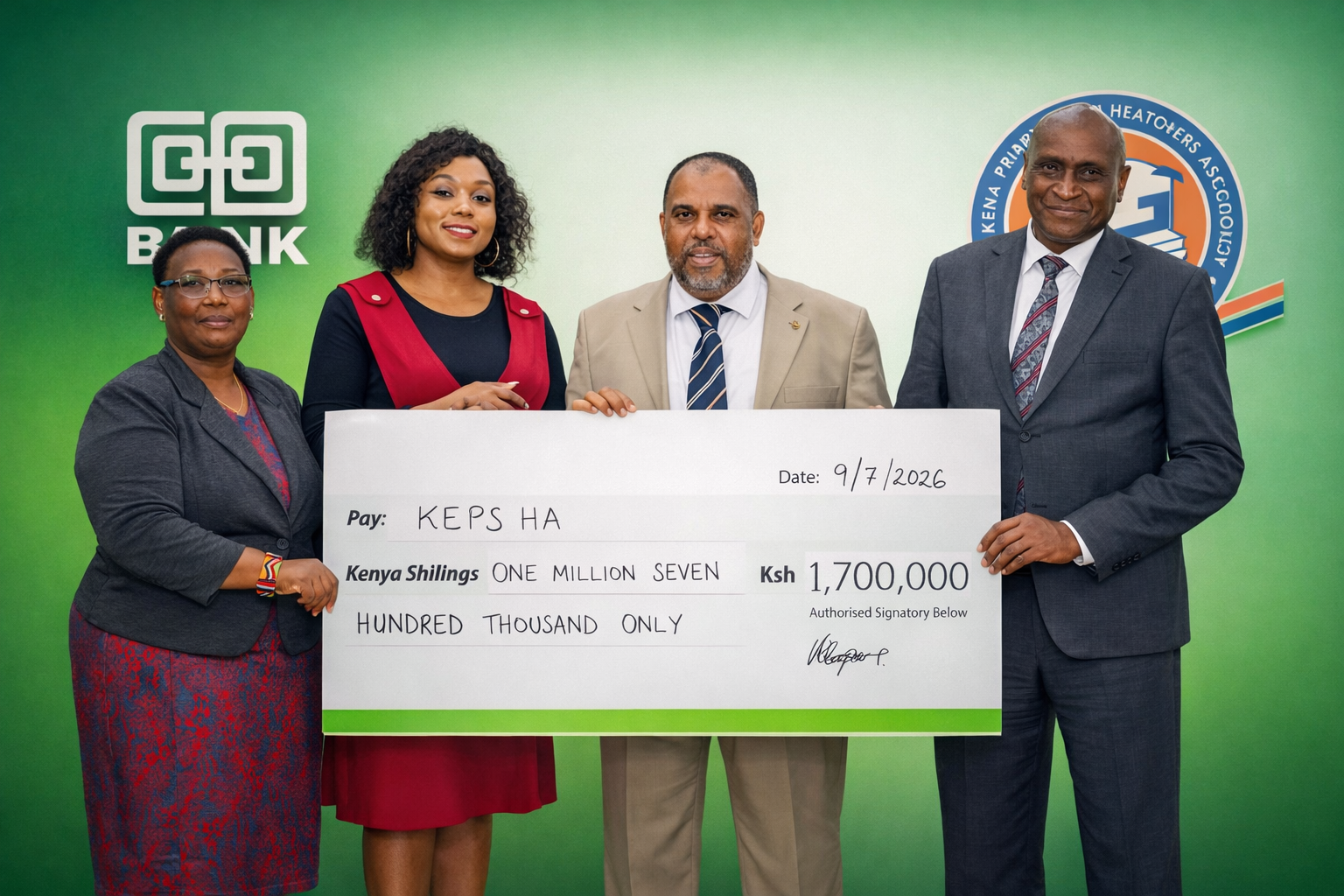
Kenya's education leadership landscape received a fresh vote of institutional confidence this week, as Co-op Bank extended sponsorship to the second National Governing Council meeting of the Kenya Comprehensive Schools Headteachers Association, a gathering that brings together the country's school leadership under one association tasked with shaping standards, advocacy, and professional development across the sector.
The funding arrangement reflects a continuation of a relationship the bank has maintained with KECSHA rather than a one off gesture, positioning the lender as a recurring partner in conversations about how schools are run and by whom.
Handover of the sponsorship took a formal, symbolic shape, with Rosemary Mapesa, Head of Consumer Banking at Co-op Bank, presenting the support directly to Fuad Ali, National Chairman of KECSHA, in a ceremony that also included Irene Yiaile, the association's National Secretary, and Kennedy Kyeva, its National Treasurer, both present to receive the gesture on behalf of the wider membership.
The presence of the association's top three officers at the handover signals the weight KECSHA itself places on the bank's continued backing, treating it as a relationship worth marking publicly rather than processing quietly through administrative channels.
For KECSHA, the governing council meeting represents more than routine internal business, since it functions as the platform through which the association reviews leadership priorities and coordinates positions ahead of engagement with policymakers; it is here that the association's direction on matters affecting school leadership nationally takes shape, rather than in the scattered, informal channels through which such positions might otherwise emerge.
The meeting also sets direction for headteachers managing schools that range from well resourced urban institutions to under equipped rural ones, meaning a national council session carries operational stakes for thousands of school leaders whose day to day decisions on staffing, discipline, and resource allocation are shaped in part by the frameworks the association develops during such gatherings.
Speaking at the handover, Mapesa framed the sponsorship within the bank's broader positioning toward the education sector, "our role goes beyond banking transactions, it extends to standing alongside the institutions and leaders shaping the country's future," said Mapesa, Head of Consumer Banking at Co-op Bank.
That framing aligns with the bank's long running WeAreYou campaign identity, under which sponsorships of this kind are typically positioned not as isolated corporate social responsibility spending but as part of a sustained presence in community and institutional life across Kenya.
From an operational standpoint, the arrangement also illustrates how commercial banks increasingly position themselves adjacent to public sector professional bodies, calculating that association level goodwill, built through funding governance meetings, conferences, and related activities, can translate into deeper penetration among the individual members those associations represent, in this instance a headteacher population that manages school accounts, staff payroll, and procurement across thousands of institutions nationally.
The broader signal for Kenya's education sector lies in the pattern such sponsorships reinforce, namely that governance and leadership infrastructure within professional associations increasingly depends on private sector funding to function at a national scale; for now, KECSHA's second National Governing Council meeting proceeds with its funding secured, and its leadership positioned to set direction for the country's headteachers with the backing of one of Kenya's largest banking institutions behind it.