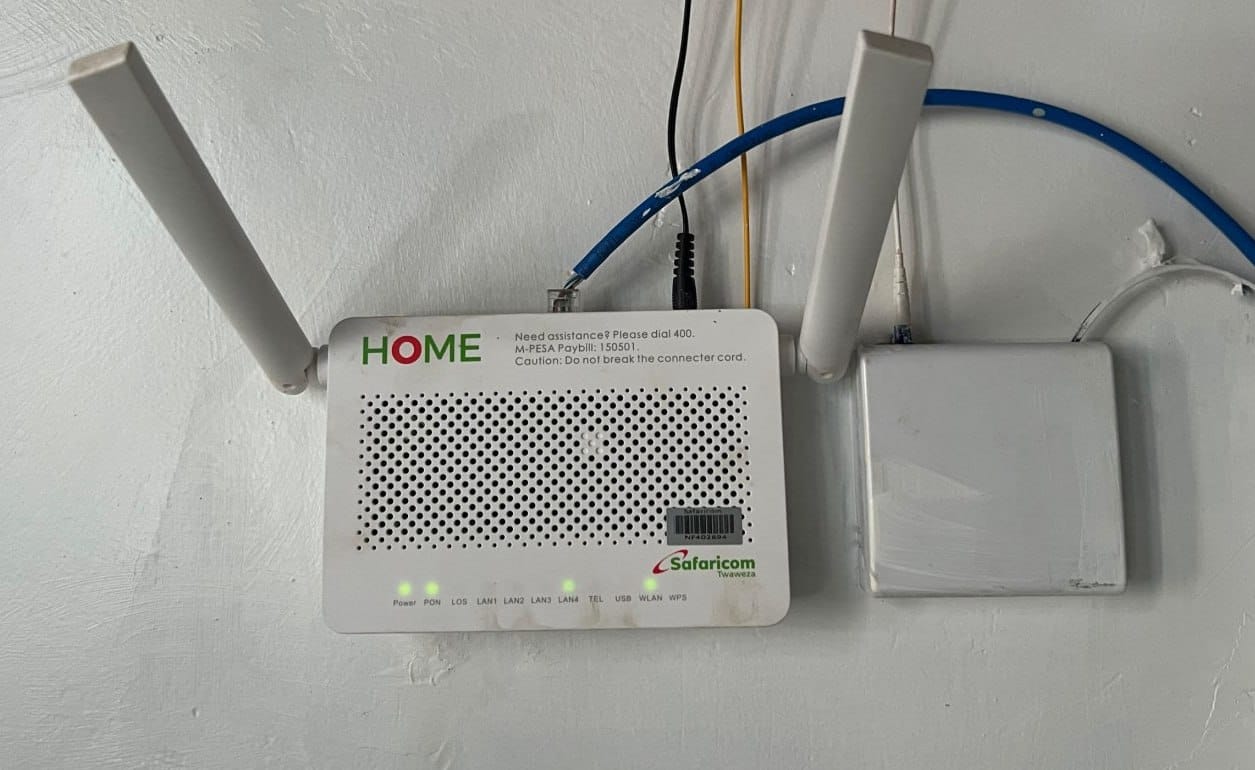
A pricing shift into Kenya’s entry-level broadband segment has placed Safaricom in direct competition with estate-based internet providers and informal Wi-Fi operators serving high-density settlements, with monthly packages starting at Ksh 800 reshaping access dynamics in lower-income urban markets.
Safaricom, Kenya’s largest telecom operator by revenue and subscriber base, is rolling out the services under its Fibre Lite and Wi-Fi Bamba products, designed to extend fixed and semi-fixed internet access into areas where demand for affordable connectivity continues to outpace traditional fibre rollout.
The product structure combines Fibre Lite, a fixed home broadband service available in selected affordable housing developments, and Wi-Fi Bamba, a pay-as-you-go wireless internet model deployed in geo-fenced zones such as Kawangware, Kangemi and Kiambu Bus Park, where users connect directly through mobile devices without installation requirements.
The company has also introduced tokenised access options priced between Ksh 15 and Ksh 100, allowing users to purchase hourly, daily or weekly internet bundles, a model designed to support users with irregular income patterns and high mobility usage.
“Wi-Fi Bamba is currently in the pilot phase within densely populated areas of Nairobi and Kiambu, specifically Kawangware, Kangemi, and Kiambu Bus Park,” Safaricom said in a statement to TechCabal.
“Subject to a successful and commercially viable pilot, we plan to scale the product to similar neighbourhoods across Kenya,” the company added.
Wi-Fi Bamba operates through wireless access points connected to Safaricom’s fibre backbone and base station infrastructure, using radio transmission to distribute connectivity within defined coverage zones rather than relying on household installation models.
“Wi-Fi Bamba is delivered via radio technology, backhauled through fibre connectivity at Safaricom base stations and distributed through a network of access points,” the telco said.
Customers access the service by connecting through mobile devices, selecting a package and completing payment via M-PESA, after which connectivity is activated instantly within the coverage area, while Fibre Lite remains structured as a fixed installation product targeting lower-cost residential zones linked to affordable housing developments.
Safaricom said its entry-level products currently deliver speeds between 10 Mbps and 20 Mbps, with monthly pricing ranging from Ksh 800 to Ksh 2,000, following a recent speed upgrade across packages without changes in pricing.
Market structure data from the Communications Authority shows Safaricom held 34.9 percent of fixed internet subscriptions at the end of 2025, while maintaining a dominant position in mobile services with 66.8 percent of subscriptions, ahead of Jamii Telecommunications Network, Wananchi Group and Poa! Internet in a fragmented broadband market.
Smaller providers such as Poa! Internet, Ahadi Wireless and Vilcom have built subscriber bases of 263,305, 222,060 and 133,316 respectively through neighbourhood-focused deployment models, flexible payment structures and localized service delivery.
The entry-level pricing strategy places Safaricom in direct competition with estate ISPs charging between Ksh 1,200 and Ksh 1,600 per month, as well as informal hotspot operators serving hourly and daily users in transport hubs and residential clusters.
The expansion into this segment reflects shifting consumption patterns, where households increasingly transition from mobile data dependence toward fixed broadband solutions driven by higher streaming, remote work and digital education demand.
If scaled beyond pilot zones, the rollout positions Safaricom within a market segment that smaller operators have developed over several years, setting up a new phase of competition at the lowest tier of Kenya’s broadband ecosystem as connectivity demand continues to expand across urban settlements.