As Nairobi hosts the historic Africa Forward Summit 2026, one of the most closely watched developments emerging from the gathering is the strengthening relationship between President William Ruto and President Emmanuel Macron.
The summit has not only elevated Kenya’s diplomatic standing on the continent but has also signaled a major shift in France’s engagement strategy in Africa.
For years, France’s political and economic influence in Africa was largely concentrated in Francophone nations in West and Central Africa.
However, changing geopolitical realities, rising anti-French sentiment in some former colonies, and increasing competition from global powers such as China, Russia, the United States, and Gulf nations have forced Paris to rethink its African partnerships. Kenya has now emerged as one of France’s most strategic allies in East Africa
An image of President William Ruto and President Emmanuel Macron during the Africa forward summit
A New Diplomatic Era Between Kenya and France
The renewed partnership between Nairobi and Paris reflects a broader effort by both countries to deepen cooperation in trade, infrastructure, climate financing, technology, and regional security.
While the growing alliance presents major economic opportunities for Kenya, it also raises important questions about debt sustainability, trade imbalances, and foreign influence in national development.
The Africa Forward Summit has provided both leaders with an opportunity to showcase a modern partnership model centered on investment and strategic cooperation rather than traditional aid dependency.
Kenya’s growing influence in regional diplomacy and economic affairs has made it increasingly attractive to European powers seeking stable and influential African partners.
Trade and Infrastructure Deals Take Center Stage
At the center of the discussions during the summit are several investment and cooperation agreements expected to shape Kenya’s economy in the coming years.
France has increasingly positioned itself as a key partner in Kenya’s infrastructure development agenda, particularly in urban mobility, transport modernization, renewable energy, and smart city planning.
French-backed financial institutions and companies have already played roles in financing transport and urban development projects in Nairobi, and the summit is expected to unlock additional investments aimed at improving public infrastructure and sustainable urban growth.
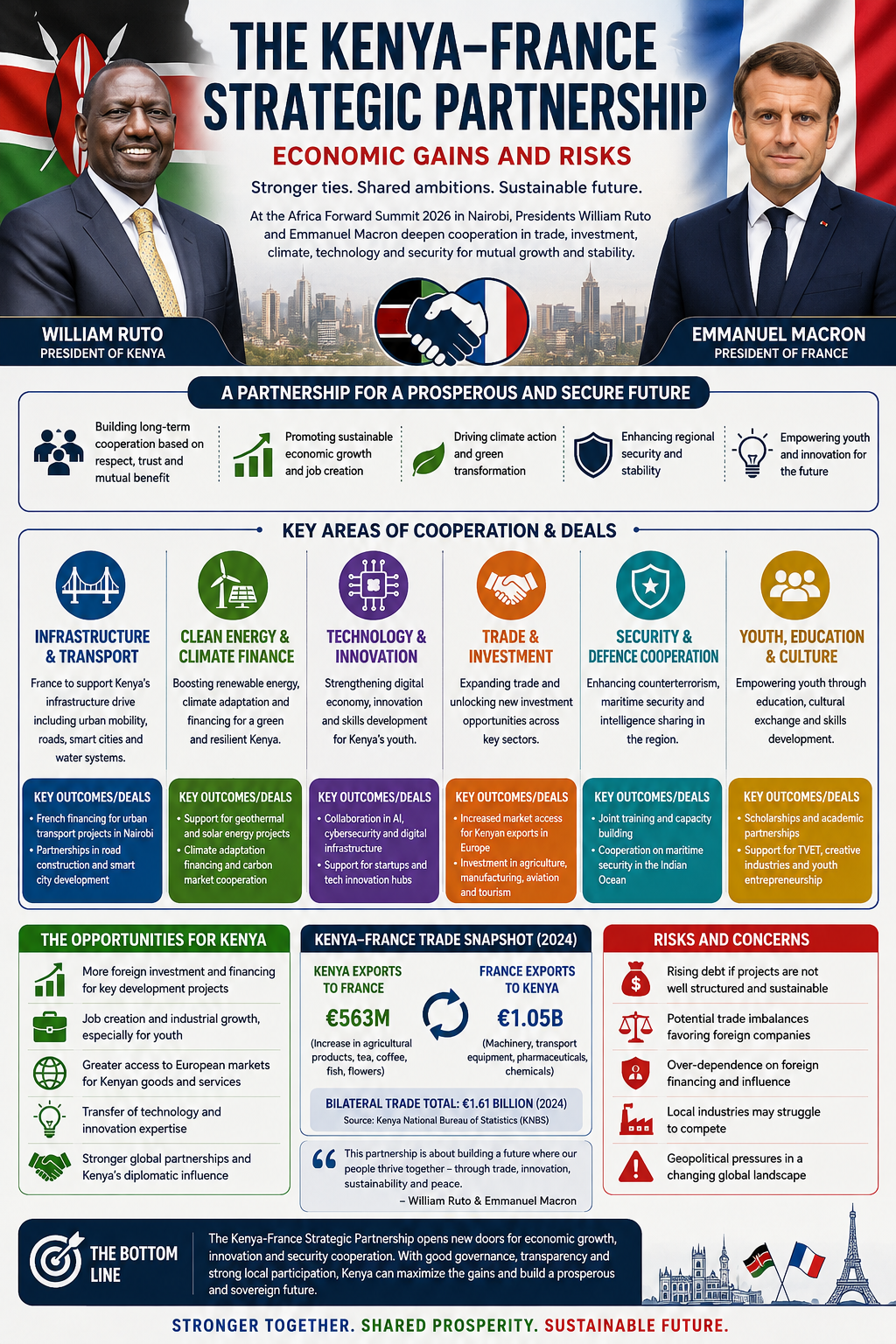
The two countries are also seeking to expand bilateral trade by strengthening cooperation in manufacturing, agriculture, tourism, aviation, pharmaceuticals, and financial services.
Kenya hopes to increase exports into European markets while attracting more foreign direct investment into sectors capable of generating jobs and supporting industrialization.
France, meanwhile, sees Kenya as a strategic commercial gateway into the East African region due to its strong transport networks, business ecosystem, and regional influence.
The Economic Opportunities for Kenya
Supporters of the Kenya-France partnership believe the relationship could unlock major economic opportunities for Kenya.
Increased French investment may help accelerate infrastructure development, renewable energy expansion, industrialization, and technology growth.
The partnership could also create employment opportunities, especially for young people, while boosting Kenya’s export potential into European markets.
Kenya’s hospitality and tourism sectors are also expected to benefit from stronger diplomatic and economic ties with France and the wider European Union.
Furthermore, the partnership strengthens Kenya’s image as a stable investment destination and a regional business hub capable of attracting global capital.
Concerns Over Debt and Foreign Influence
Despite the optimism surrounding the partnership, concerns remain about the long-term implications for Kenya’s economy and sovereignty.
Critics argue that while foreign investments can accelerate development, they often come with financial obligations that could increase debt pressures if not managed carefully.
Kenya is already facing concerns over rising public debt, and some analysts warn that additional externally financed infrastructure projects could deepen fiscal vulnerabilities if transparency and accountability mechanisms are not strengthened.
There are also fears that local businesses may struggle to compete with large multinational corporations entering the Kenyan market through such partnerships.
Without strong policies to promote local participation and technology transfer, the economic benefits may disproportionately favor foreign firms.
Others caution that overreliance on foreign powers for financing, security cooperation, and development could expose Kenya to geopolitical pressure in the future.
Kenya’s Growing Global Influence
The Kenya-France partnership reflects broader changes in Africa’s global positioning.
Africa is increasingly viewed as a strategic investment destination, a climate partner, a technology frontier, and a geopolitical battleground for global influence.
Kenya’s ability to host major diplomatic gatherings such as the Africa Forward Summit demonstrates its growing importance in continental and international affairs.
For President Ruto, strengthening ties with France supports his broader foreign policy vision of positioning Kenya as a diplomatic leader, green economy champion, and gateway into Africa.
For President Macron, closer ties with Kenya offer France an opportunity to maintain influence in Africa through investment, diplomacy, and strategic cooperation rather than traditional political dominance
Conclusion
As the Africa Forward Summit continues in Nairobi, the Kenya-France relationship is emerging as one of the defining diplomatic stories of the event.
The partnership has the potential to unlock major opportunities in trade, infrastructure, climate financing, technology, and security cooperation.
However, the long-term success of the alliance will depend on transparency, balanced negotiations, sustainable financing, and ensuring that ordinary Kenyans benefit from the investments and agreements being signed.
What is already clear is that Kenya is steadily positioning itself as one of Africa’s most influential diplomatic and economic powers and global leaders are taking notice.