Safaricom PLC has closed a defining six-year chapter under Chief Executive Peter Ndegwa, a period that reshaped the company’s revenue model, tested its resilience through the pandemic, and pushed it into new regional markets.
Since April 2020, when Ndegwa became the first Kenyan to lead the telecommunications giant, Safaricom has navigated declining voice revenues, the COVID-19 crisis, and a costly expansion into Ethiopia, while simultaneously elevating M-PESA into the company’s dominant growth engine.
Ndegwa’s appointment came at a moment of transition, following the passing of Bob Collymore and interim stewardship by Michael Joseph. The company faced structural decline in voice and messaging revenues, once its traditional backbone. “There are some roles you don’t decline,” said Ndegwa, reflecting on his decision to take the helm.
His first weeks coincided with Kenya’s airport closures in April 2020, forcing him to lead remotely. Safaricom quickly adapted, establishing the Ministry of Health’s COVID-19 call centre and zero-rating M-PESA transactions for nine months, a move that supported millions of Kenyans during lockdown. At the same time, Safaricom accelerated its 4G rollout, expanding coverage from 50 percent to over 90 percent in a single year.
With domestic operations stabilized, Ndegwa turned to Ethiopia, securing a licence in April 2021 and launching services in Addis Ababa and eleven cities by October 2022. The venture marked Safaricom’s first international expansion, backed by a consortium investment of US$2.65 billion, with Safaricom’s equity contribution at US$1.22 billion.
Yet the Ethiopian Birr’s collapse from 57 to 146 against the dollar eroded returns, pushing Safaricom from a net cash position of Ksh 3.54 billion in FY20 to net debt of Ksh 139.81 billion by FY26. Executives described the early years as untenable, with services sold below cost, underscoring the financial strain of the expansion.
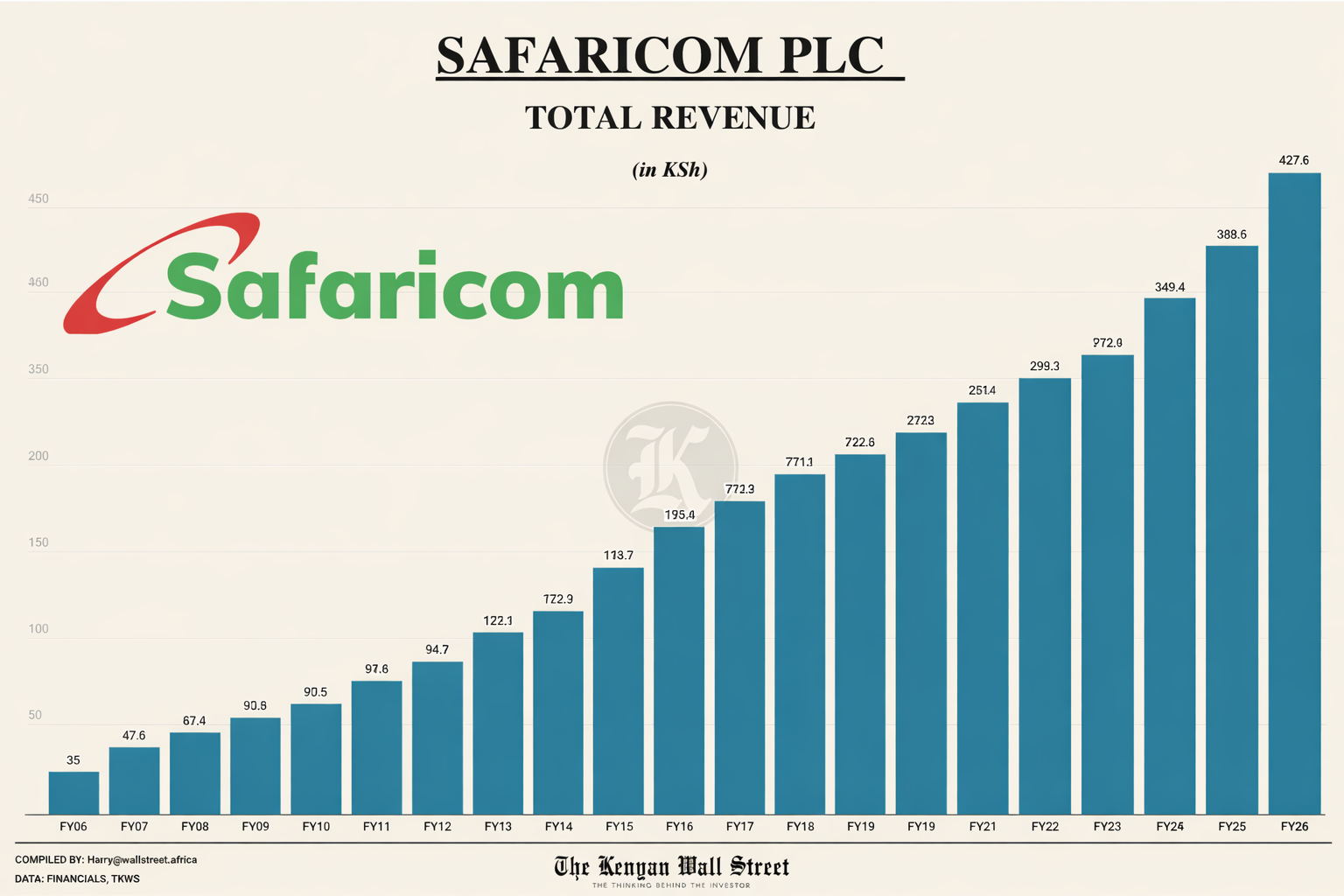
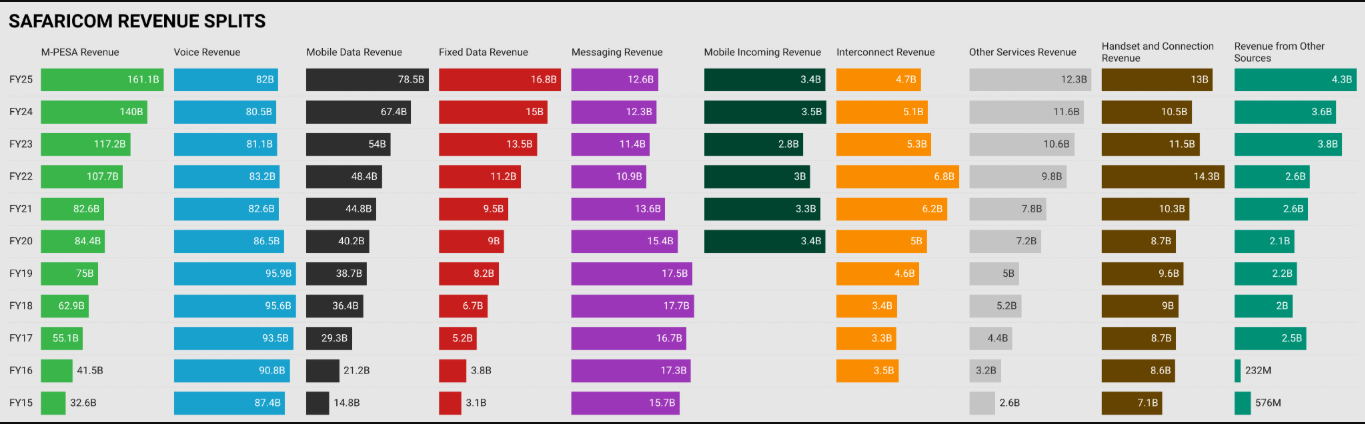
The company’s revenue revival came from within. M-PESA, launched in 2007, was repositioned under Ndegwa as Safaricom’s central growth driver. In FY20, M-PESA generated Ksh 84.44 billion, accounting for 32.2 percent of revenue, compared to voice at Ksh 86.53 billion.
By FY21, M-PESA had overtaken voice, and in FY22 it crossed Ksh 100 billion for the first time, reaching Ksh 107.69 billion. By FY26, M-PESA revenue had more than doubled to Ksh 182.74 billion, representing 42.7 percent of total revenue, with transaction volumes tripling from Ksh 13.94 trillion to Ksh 41.68 trillion annually. Voice revenue, by contrast, remained flat at Ksh 84.83 billion.
Safaricom’s overall financial trajectory reflected this transformation. Total revenue rose from Ksh 262.56 billion in FY20 to Ksh 427.56 billion in FY26, a 62.9 percent increase. Group EBITDA climbed from Ksh 138.04 billion to Ksh 220.26 billion, while net profit attributable to equity holders reached a record Ksh 95.61 billion, the highest in East and Central Africa.
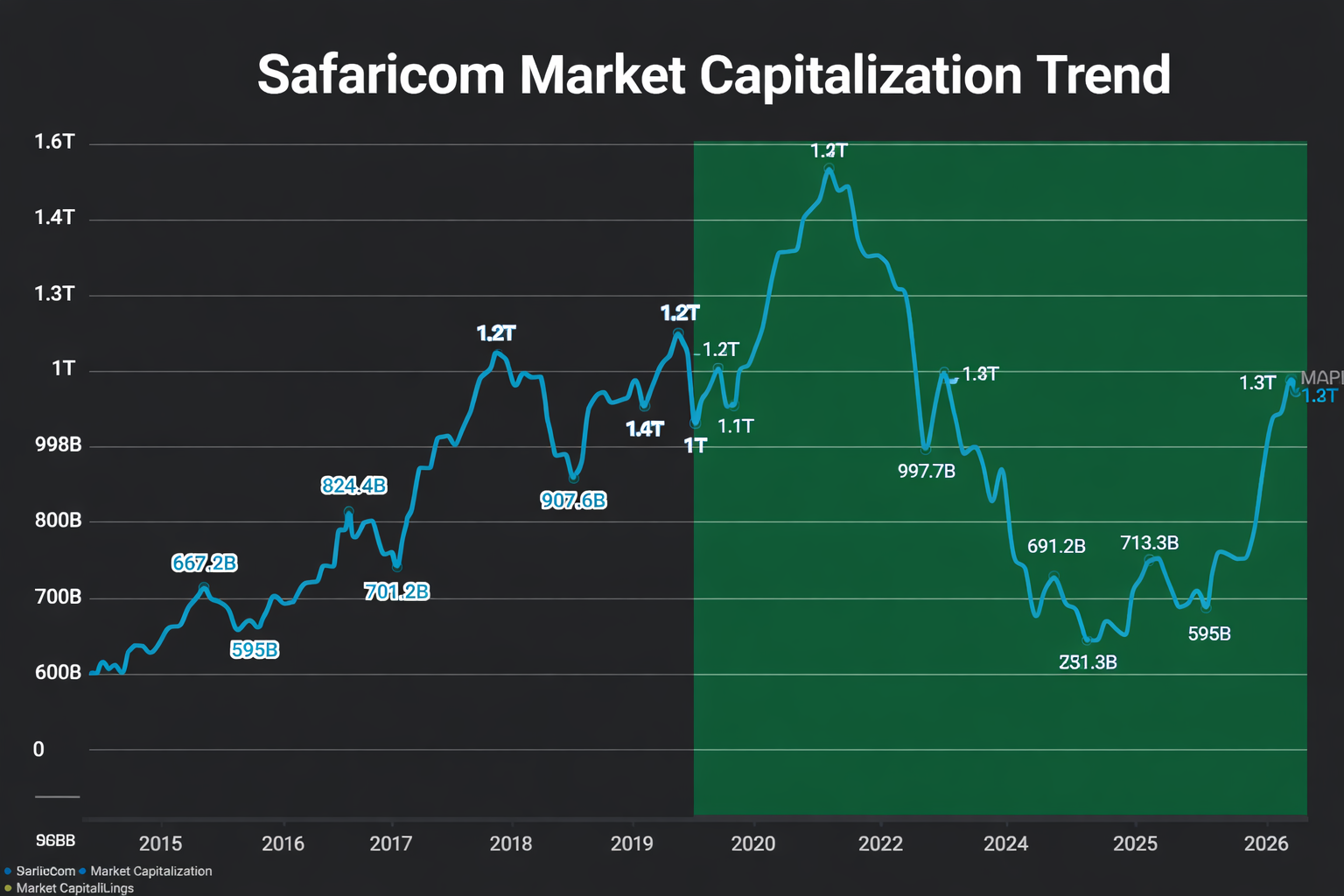
The company’s share price, which had fallen to Ksh 13.30 in February 2024 amid Ethiopia-related losses, rebounded to Ksh 31.40 by June 2026, restoring market capitalization above Ksh 1.25 trillion.
“People won’t give you fluffy stories. They’ll tell you here it is,” said Ndegwa, recalling the clarity of leadership during crisis. His tenure has been defined by balancing risk and resilience: absorbing the financial weight of Ethiopia while unlocking unprecedented growth through M-PESA.
As Safaricom enters its next phase, the numbers tell a story of both ambition and adaptation, positioning the company as a regional benchmark for telecoms innovation and financial performance.