A Kenya Wildlife Service veterinary crew has patched up an adult male lion in the Maasai Mara National Reserve, stepping in after park visitors flagged rangers to an animal in visible distress.
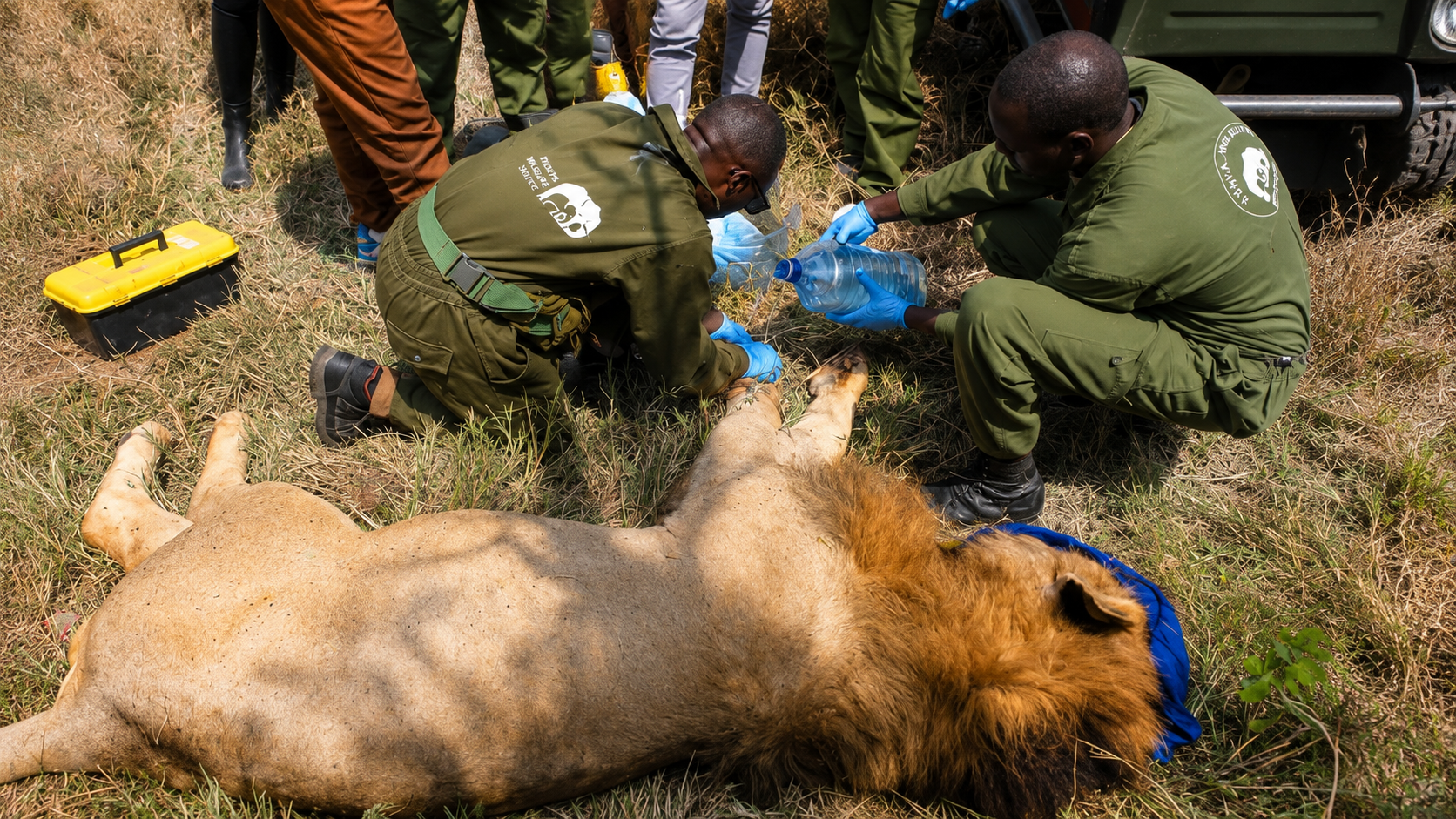
The lion, known as Kidong'oe, or Half Tail, turned up in the Olkeju Rongai area bearing a deep gash to the neck that officials trace to a buffalo he likely tangled with during a hunt gone wrong.
Beyond that wound, the medical team also spotted fresher bite marks scattered across his head and sides, damage they linked to a separate and more recent scrap over turf.
KWS identified the lion as a member of the Rongai Rockers coalition, tagged R5 in agency records, and noted he descends from Olobor, a male well known within the reserve's tracked lion population.
Officials tied the territorial wounds to the coalition's ongoing push to muscle in on ground held by the Rekero Pride, describing the resulting friction as typical of how rival male groups jockey for dominance across the ecosystem.
Once the animal was sedated, vets got to work cleaning out each wound and stitching closed the worst of them.
They followed that with a course of long acting antibiotics and anti-inflammatory drugs, then reversed the sedation once treatment wrapped up.
"The team cleaned and treated each wound, sutured the most severe injuries, and administered long-acting antibiotics and anti-inflammatory medication before safely reversing the anaesthesia," the agency said in describing the procedure.
KWS reports the lion is responding well and should recover fully, crediting much of that outcome to how fast visitors flagged the situation to rangers on the ground.
That early warning, officials say, often makes the difference between catching an injury while it's still treatable and letting it fester into something worse, particularly in a setting where a weakened predator stays exposed to rivals and scavengers alike.
Rather than treating the episode as unusual, the agency framed it as an ordinary hazard of life in the wild, where lions regularly take physical risks chasing prey, holding ground, and fending off competing males.
That view fits within a broader conservation stance: these clashes aren't emergencies to be alarmed by so much as expected wear and tear within a predator population that's otherwise functioning normally, one where timely human help still matters when an injury turns serious.
KWS closed by thanking the tourists whose tip set the rescue in motion and renewed its call for the public to keep reporting distressed animals and backing conservation work more broadly.
The incident folds into a growing pattern of tourist tipped wildlife cases across the Mara, encounters that increasingly shape how the agency directs its stretched veterinary resources in a reserve where predators, visitor traffic, and territorial pressure keep overlapping, and where an alert public has effectively become an extra set of eyes for the agency's own monitoring work.