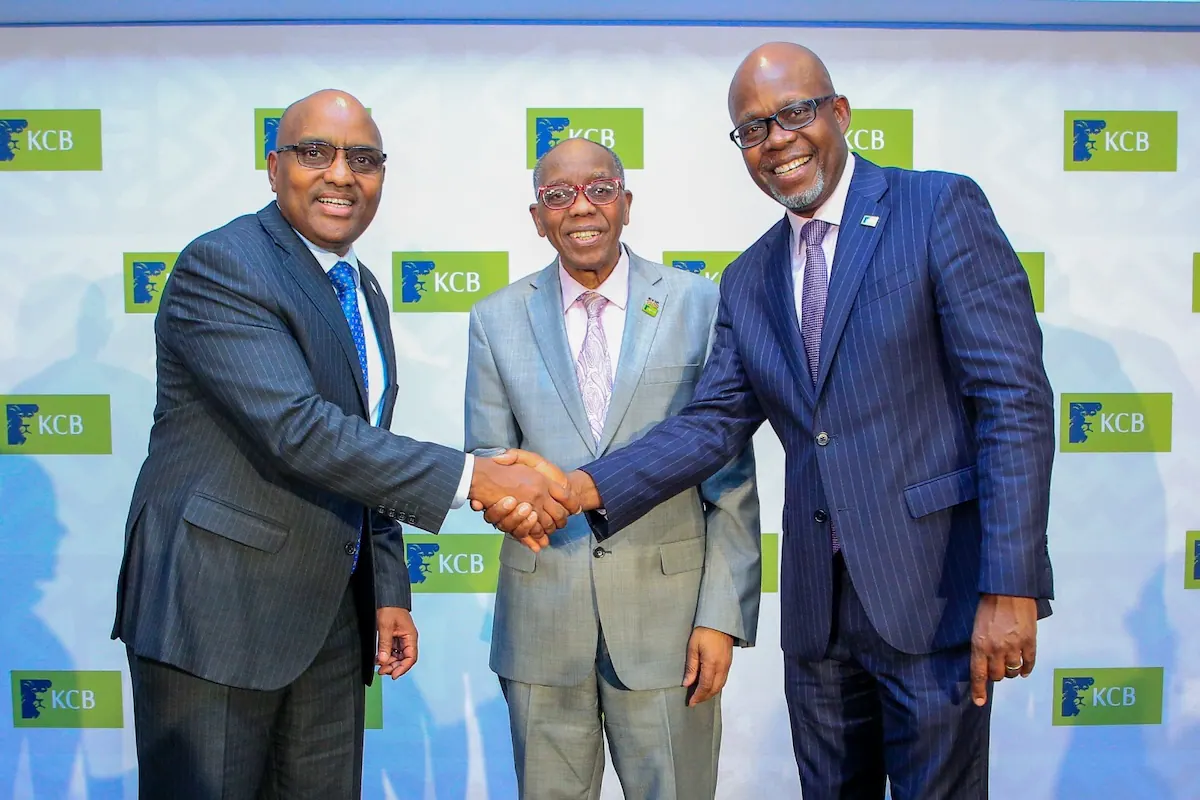
KCB Group PLC announced that profit after tax for the nine months ended September 30, 2026 grew by 24 per cent to KSh58.6 billion, up from KSh47.3 billion in the comparable period of 2025.
Earnings per share increased by 24.3 per cent to KSh17.8 and the Group’s asset base expanded by 15.4 per cent to KSh2.4 trillion, driven by a 15.0 per cent rise in customer deposits to KSh1.8 trillion and an 11.0 per cent increase in gross loans to KSh1.4 trillion.
Within Kenya, KCB Bank Kenya posted a 20.7 per cent jump in profit after tax to KSh40.8 billion as its balance sheet grew 13.0 per cent to KSh1.6 trillion.
Profit after tax from subsidiaries outside Kenya rose 24.3 per cent to KSh19.6 billion, representing 33.4 per cent of the Group’s net profit and 33.0 per cent of its total balance sheet, with strong contributions from units in Burundi, South Sudan, Uganda, KCB Investment Bank and KCB Corporate Trustee Services.
The three main non-banking subsidiaries together generated a profit before tax of KSh1.9 billion, including a 393.9 per cent surge in earnings at KCB Investment Bank to KSh1.1 billion, a 118.6 per cent jump at KCB Corporate Trustee Services to KSh258 million, and a profit before tax of KSh471 million at KCB Bancassurance Intermediary.
Total income rose 12.3 per cent to KSh167.8 billion, with funded income up 8.2 per cent to KSh112.9 billion and non-funded income climbing 21.8 per cent to KSh54.9 billion, the latter boosted by a 65.1 per cent increase in foreign-exchange income largely from Trust Merchant Bank in the Democratic Republic of Congo.
Mobile loan disbursements grew 26.0 per cent to KSh492 billion, averaging KSh1.8 billion per day, while operating costs increased 6.1 per cent as the Group invested in technology and branch expansion.
Faster income growth reduced the cost-to-income ratio to 43.7 per cent from 46.2 per cent a year earlier.
Gross non-performing loans fell 17.1 per cent to KSh184.1 billion, lowering the NPL ratio to 13.3 per cent from 17.8 per cent, and loan loss provisions declined 9.1 per cent to KSh16.6 billion, improving the cost of risk to 1.7 per cent from 2.1 per cent.
Shareholder equity rose 17.3 per cent to KSh362.0 billion, delivering a return on equity of 22.1 per cent and a return on assets of 3.5 per cent, up from 3.1 per cent, while the loan-to-deposit ratio held at 78.7 per cent.
Core capital to risk-weighted assets stood at 18.0 per cent, well above the 10.5 per cent statutory floor, and the total capital ratio was 21.1 per cent against a 14.5 per cent requirement; Tier II funding was earmarked for climate and MSME lending.
In the sustainability arena, the Group disbursed KSh20.8 billion in green loans and screened KSh451.0 billion of loan proposals under its Environmental and Social Due Diligence framework during the nine-month period.
Strategic moves included raising the Group’s stake in Trust Merchant Bank from 85 per cent to 98 per cent in September, unveiling a Sustainability Bond Framework ahead of a planned KSh300 billion medium-term note programme, and launching a co-branded prepaid grocery card with Carrefour and Mastercard alongside youth-focused products and events.
The KCB Foundation reported support for more than 55,002 jobs and 5,283 disadvantaged scholars, while the bank earned recognition as one of Forbes’ World’s Top 500 Performing Banks and as Best Trade Finance Bank in Kenya at the GTR+ MEA Leaders in Trade Awards 2026.
“Our investments in technology, customer experience and regional business capabilities continue to translate into stronger performance, positioning the bank for sustained growth,” said KCB Group Chief Executive Paul Russo.
Chairman Joseph Kinyua added that “The strong capital buffers provide the group with sufficient headroom to absorb potential economic shocks, support future business expansion and sustain lending to customers across its markets.”