KCB Group Plc reported profit after tax of KSh58.6bn for the nine months ended September 2026, a rise of 24 per cent year-on-year. Earnings per share increased 24.3 per cent to KSh17.80.
Total assets grew 15.4 per cent to KSh2.4 trillion, driven by a 15 per cent increase in customer deposits to KSh1.8 trillion and an 11 per cent rise in gross loans to KSh1.4 trillion.
KCB Bank Kenya posted a 20.7 per cent jump in profit after tax to KSh40.8bn and its balance sheet expanded 13 per cent to KSh1.6 trillion. Profit after tax from subsidiaries outside Kenya rose 24.3 per cent to KSh19.6bn, representing 33.4 per cent of the Group’s net profit.
The subsidiaries that contributed strongly included KCB Bank Burundi, KCB Bank South Sudan, KCB Bank Uganda, Trust Merchant Bank, KCB Investment Bank and KCB Corporate Trustee Services.
Total income for the period increased 12.3 per cent to KSh167.8bn, up from KSh149.4bn a year earlier. Non-funded income grew 21.8 per cent to KSh54.9bn, reflecting higher transaction activity and digital services.
Mobile loan disbursements rose 26 per cent to KSh492bn, equivalent to about KSh1.8bn each day. Foreign-exchange income surged 65.1 per cent, while funded income climbed 8.2 per cent to KSh112.9bn.
The cost-to-income ratio improved to 43.7 per cent from 46.2 per cent, even though total operating costs rose 6.1 per cent due to technology and expansion spending.
Asset quality improved with gross non-performing loans falling 17.1 per cent to KSh184.1bn and the NPL ratio dropping to 13.3 per cent from 17.8 per cent. Loan-loss provisions declined 9.1 per cent to KSh16.6bn and the cost of risk fell to 1.7 per cent from 2.1 per cent.
KCB Bank Kenya’s non-performing loan stock fell 19.5 per cent, a reduction of KSh39.3bn.
Return on equity stood at 22.1 per cent and return on assets rose to 3.5 per cent from 3.1 per cent. Shareholder equity increased 17.3 per cent to KSh362bn.
The Group’s core capital to risk-weighted assets ratio was 18 per cent and its total capital ratio 21.1 per cent, both above regulatory minima. The loan-to-deposit ratio was 78.7 per cent.
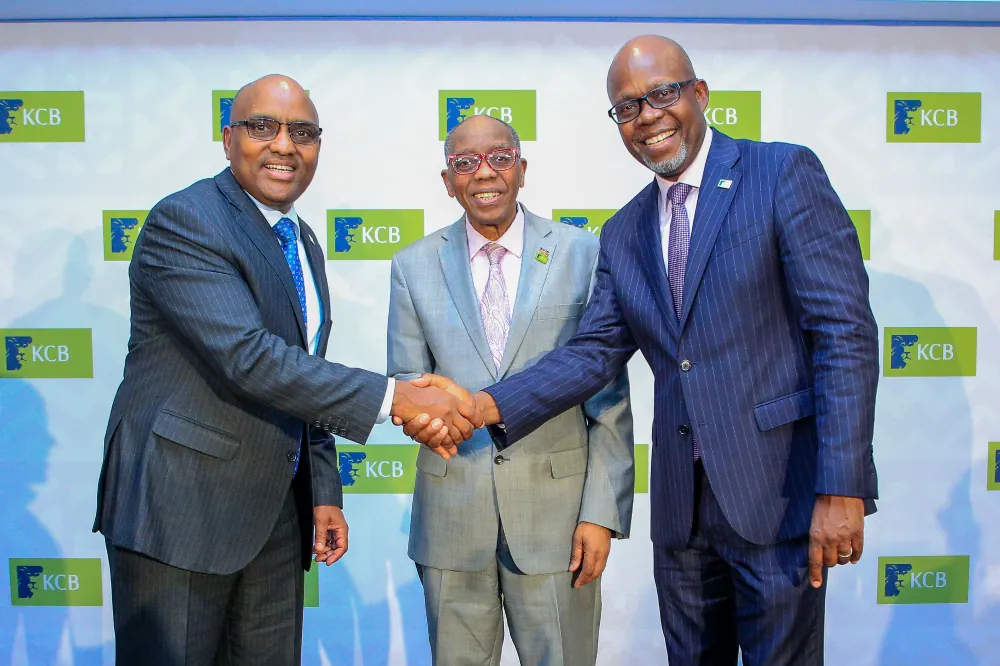
Chief Executive Officer Paul Russo said the results showed the resilience of the business and progress toward a stronger, more diversified financial services institution. He added, “Our investments in technology, customer experience and regional business capabilities continue to translate into stronger performance, positioning the Bank for sustained growth.”
Chairman Dr Joseph Kinyua noted that the capital buffers give capacity to absorb shocks and support expansion, and said, “As we enter the final stretch of the year, our priority is to consolidate the gains we have made while positioning the business for sustainable growth.”
In September 2026 the Group raised its shareholding in Trust Merchant Bank from 85 per cent to 98 per cent, deepening its presence in the Democratic Republic of Congo. It also partnered with Carrefour and Mastercard to launch a prepaid card aimed at grocery budgeting.
August saw the launch of a Sustainability Bond Framework that underpins a planned KSh300bn medium-term note programme over five years to fund environmentally and socially beneficial projects. The bank continued its Pata Kwako home-ownership campaign, offering a Kenya Mortgage Guarantee Trust-backed loan for up to 15 years at 9.9 per cent interest to eligible MSMEs and gig-economy participants.
The KCB Foundation reported support for more than 55,002 jobs through programmes such as 2Jiajiri, DiGiFLME, Mifugo ni Mali, Ikamba and Iteze Imbere, and the KCB Scholars initiative assisted 5,283 disadvantaged students.
KCB Group was named among Forbes Magazine’s World’s Top 500 Performing Banks and won Best Trade Finance Bank in Kenya at the GTR+ MEA Leaders in Trade Awards 2026.