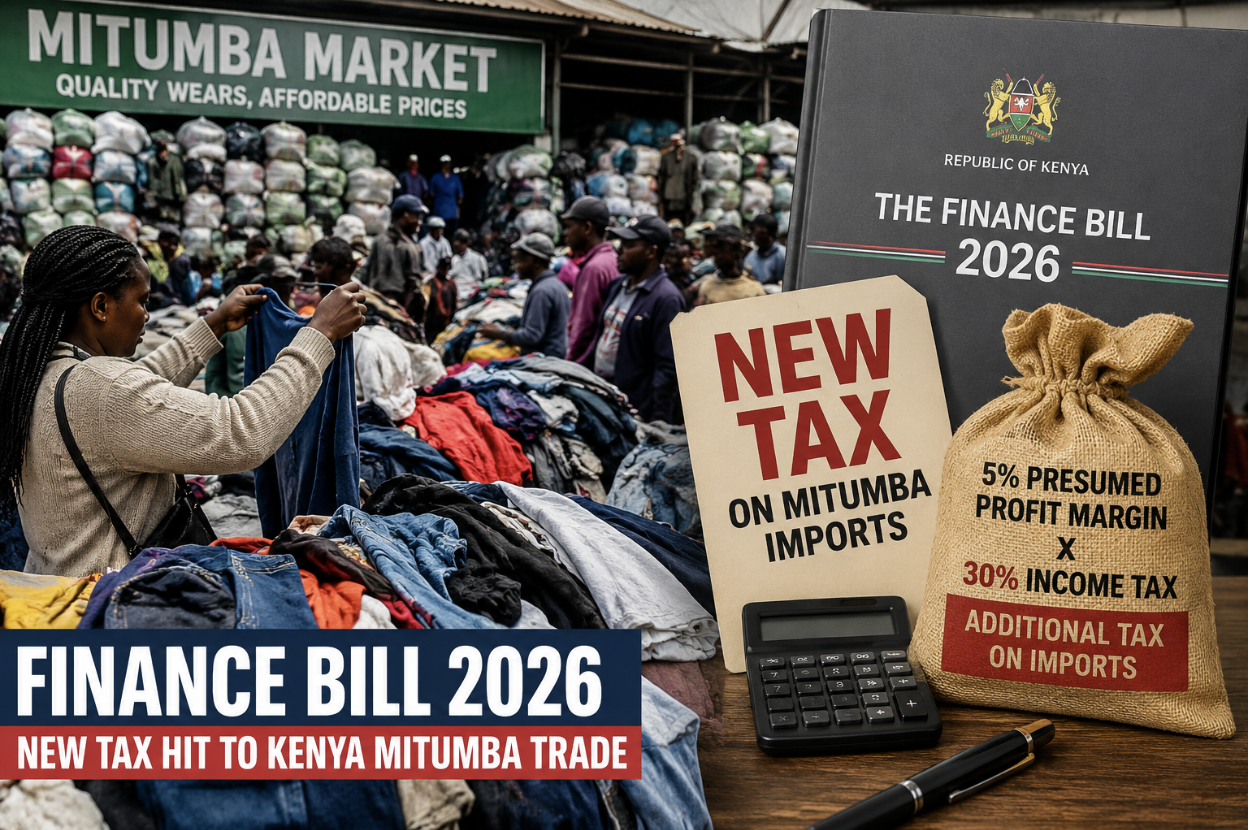
A new fiscal squeeze on mitumba trade
Kenya’s Finance Bill 2026 has introduced new tax measures that are expected to reshape the country’s mitumba (second-hand clothing) sector.
The proposals come at a time when the industry remains a critical source of affordable clothing and livelihoods for thousands of traders across the country.
New tax framework on imports
The Bill retains the existing 16% VAT on imported second-hand clothing but introduces an additional income tax mechanism based on estimated profitability.
Under this system, mitumba traders are presumed to earn a 5% profit margin on the customs value of imported goods, which is then taxed at 30%.
This effectively creates a structured tax obligation applied at the point of importation, shifting the basis of taxation from declared earnings to assumed income.
Government justification for the tax changes
The National Treasury has defended the new framework as a way to strengthen tax compliance and reduce under-declaration of income within the informal sector.
The model is also intended to simplify tax administration by standardising how income is assessed for importers in the mitumba trade.
Authorities argue that this approach will improve revenue collection and reduce disputes that often arise from inconsistent reporting of profits.
Impact on traders and pricing
The new tax measures are expected to increase the cost of importing second-hand clothing. As a result, wholesalers and retailers are likely to adjust prices to absorb the additional tax burden.
Markets such as Gikomba and Eastleigh could see higher wholesale and retail prices, with small-scale traders particularly affected due to already narrow profit margins.
There is also concern that higher prices may reduce demand among consumers who depend on affordable clothing options.
Pressure on the informal economy
The mitumba sector is deeply embedded in Kenya’s informal economy, supporting not only traders but also transporters and small-scale retail networks.
Any increase in taxation is therefore likely to have a ripple effect across multiple livelihoods linked to the trade.
Stakeholders warn that tighter margins could strain small businesses and potentially disrupt one of the country’s most accessible economic sectors.
Broader concerns and outlook
While the government maintains that the reforms are necessary to broaden the tax base, concerns persist about affordability and the long-term sustainability of the sector.
The Finance Bill 2026 is still under parliamentary consideration and may undergo revisions before enactment.
The outcome will determine whether the mitumba trade adapts to a more formalised tax regime or faces increased pressure that could reshape its structure.