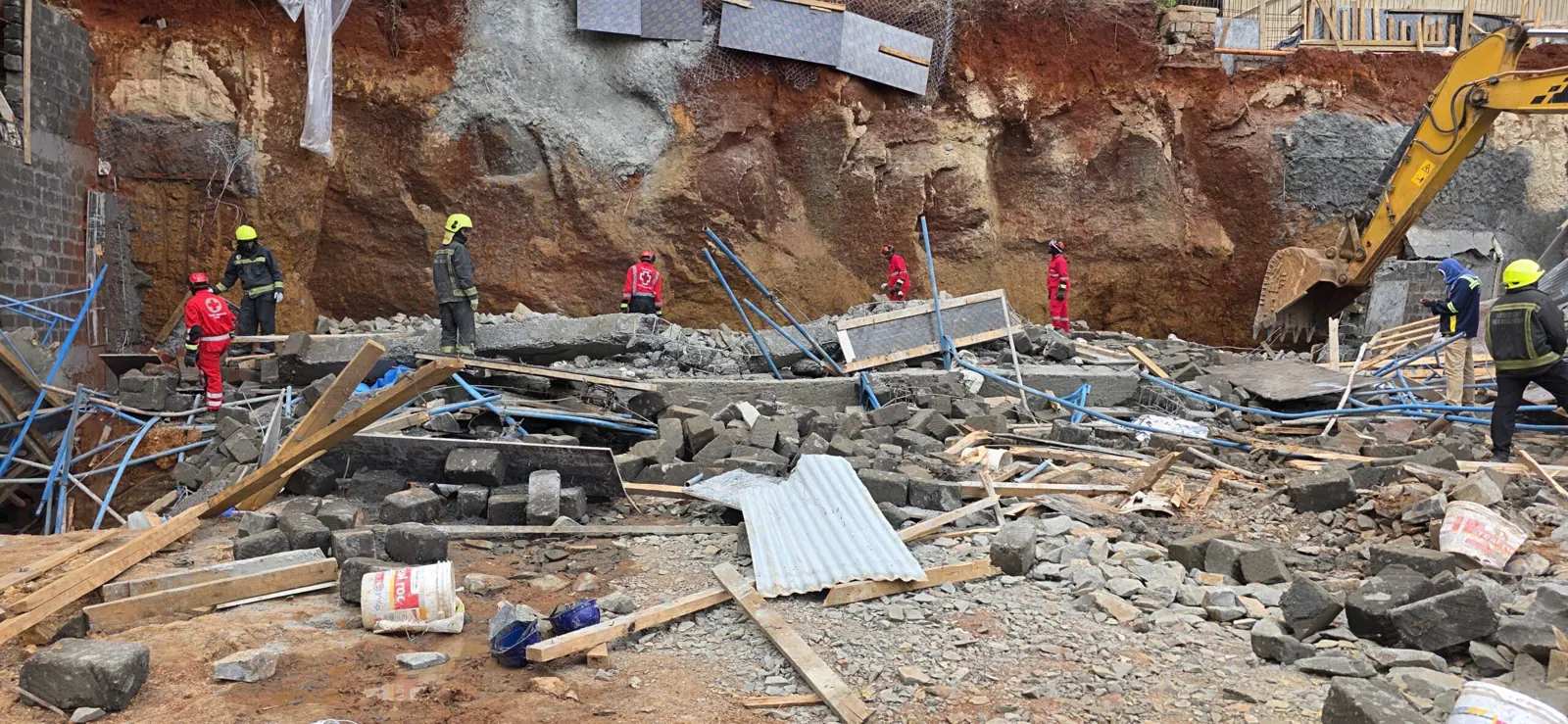
Stats Kenya’s database records at least 84 building collapses in Kenya since January 2020, resulting in a minimum of 102 deaths, and shows that 78 per cent of those fatalities occurred at sites under construction or demolition.
The latest three incidents happened within 22 days, with the Eastleigh collapse on October 23, 2026 killing eight people, the Syokimau slab failure on November 13 and the Riverside retaining-wall failure on November 14, all while the structures were being built.
Police at Syokimau confirmed that 405 workers were present and all were accounted for; assistant inspector general of police Duncan Ochieng said, “So far we have confirmed six bodies, but also five people have been rushed to Imara Daima Hospital.”
Nairobi County reported that 39 workers were on the Riverside site when the wall gave way and that the Kenya Red Cross dispatched action teams and ambulances.
The Institution of Engineers of Kenya (IEK) has urged national and county authorities, the National Construction Authority, the Engineers Board of Kenya and other regulators to launch independent technical investigations, preserve evidence and halt work in the affected areas until safety clearance is granted.
IEK also recommended that only registered engineers supervise design and construction until Occupation Certificates are issued, that high-risk projects undergo risk-based audits and that a national review of safety regulations be undertaken with clear timelines and public reporting.
Nairobi City County’s Development Control Policy 2026 and Integrated Development Plan already target unauthorised building work, allocating KSh85 million over five years for surveillance and statutory inspections.
The National Construction Authority’s 2018 assessment of 14,895 buildings found 10,791 required demolition or strengthening and only 2,194 deemed safe; its 2020 report recorded 87 collapses in the preceding five years with about 200 deaths, and in 2022 it inspected 26,060 projects and suspended 18,192, representing 69.8 per cent, for breaching building regulations.
Governor Johnson Sakaja told residents in Eastleigh on October 24 that the application for a 15-storey building with a basement had never been granted, stating, “The application was never granted, meaning there is no approval for this construction.”
He added that a change-of-use application was approved in 2024, that the Urban Planning Committee raised concerns in November 2024 and that an enforcement order was issued earlier this year, and that the county had forwarded related documents to police and the Directorate of Criminal Investigations while seeking prosecution powers from the Director of Public Prosecutions.
A Capital FM report noted a counter claim that the DPP’s office said City Hall had not submitted an inquiry file on the Eastleigh collapse.
For developers, lenders and off-plan buyers, projects with approval gaps now face possible stop orders, demolition risk and delayed loan repayments, while sites that pass inspection retain their permits and occupation-certificate pathways, which the county links to full payment of the Development Impact Fee.