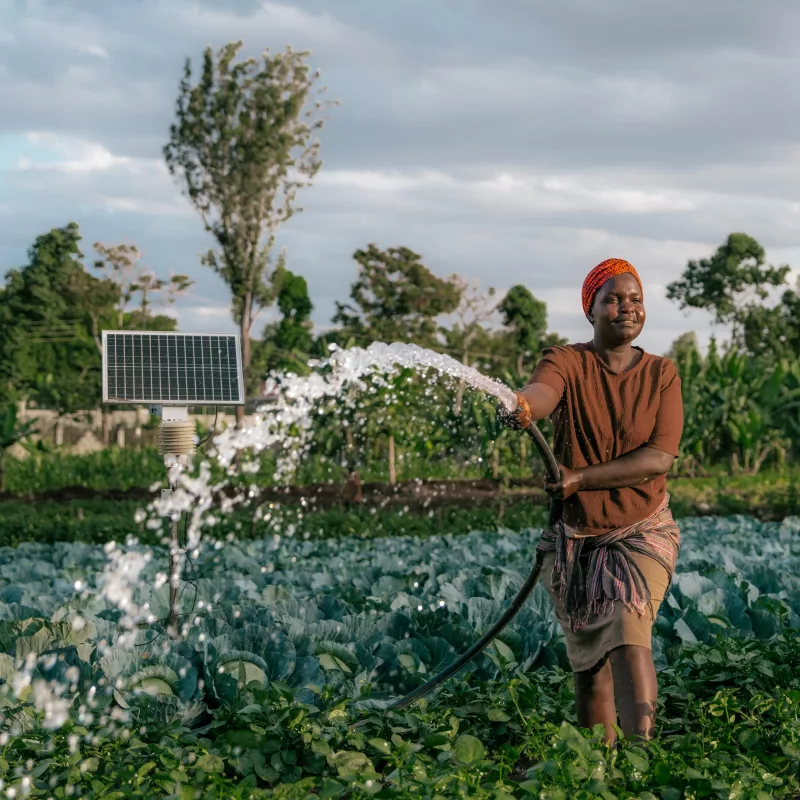
A World Bank and Global Off-Grid Lighting Association (GOGLA) report says solar-powered irrigation could help Kenyan smallholders sustain production during dry spells, but financing remains a major barrier, a reality illustrated by farmer Sylvester Oluoch in Ugenya.
Oluoch explained that the short rains this season left his vegetable crops wilted and his maize “folded like onions”, raising concerns about unpaid school fees, mounting debts, reduced meals and uncertainty for the next planting season.
The Off-Grid Solar Market Trends Report 2026 notes that sunlight-driven pumps can draw water from rivers or boreholes without relying on expensive fuel or grid electricity, yet many farmers question whether they can afford the technology.
The Kenya National Bureau of Statistics (KNBS) Economic Survey 2026 recorded agricultural growth slowing to 2.8 per cent in 2025 from 4.3 per cent in 2024, attributing the decline to uneven weather and structural challenges, including below-average short rains.
GOGLA Executive Director Sarah Malm said solar irrigation reduces dependence on diesel-powered pumps and can provide consistent daylight watering, but “financing has not kept pace with what off-grid solar is being asked to do.”
World Bank research on off-grid solar added that low income levels among smallholder farmers make affordability a significant barrier to wider uptake.
The Kenyan government is piloting solar irrigation through the Financing Locally Led Climate Action (FLLoCA) Programme, jointly funded by the Kenyan government, the World Bank, the Ministry of Foreign Affairs of Denmark (DANIDA), the Swedish International Development Cooperation Agency (SIDA) and the German government; a beneficiary in Tana River, Doyo Mwajuma, said solar energy has lowered farming costs and enabled expansion of vegetable, maize and fruit production.
The World Bank report found that global off-grid solar users grew 26 per cent between 2023 and 2025, reaching 149 million from 118 million, and identified off-grid solar as the least-cost electricity solution for at least 398 million people lacking access, with 7.4 million using it for micro-enterprises.
The same report highlighted the initial cost as the biggest obstacle, noting that solar water pump sales have plateaued and that low incomes limit uptake of productive-use technologies.
A 2025 GOGLA study reported that 40 per cent of customers in its analysed portfolios struggled to pay instalments for pay-as-you-go solar systems.
Irrigation Principal Secretary Ephantus Kimotho said access to credit is one of the biggest barriers, describing a results-based financing (RBF) model in which suppliers receive rebates after verified installation of working irrigation equipment to lower costs for farmers and reduce market risks.
A ten-year blueprint (2025–2035) anchored on the Farmer-Led Irrigation Development (FLID) approach under the National Irrigation Sector Investment Plan (NISIP) targets more than five million farmers and about 350,000 acres, enabling individual farmers and small groups with half to two hectares to invest in suitable irrigation systems.
The blueprint also promotes shared irrigation facilities, allowing several farmers to pool resources for a pumping system rather than each purchasing one independently.
Through the Kenya Off-Grid Solar Access Project (KOSAP), a partnership with the World Bank, the government has established mini-grids and supported companies providing solar home systems; Kenya now has 210 megawatts of solar power connected to the national grid and more than one million solar home systems installed, significantly increasing electricity access nationwide.