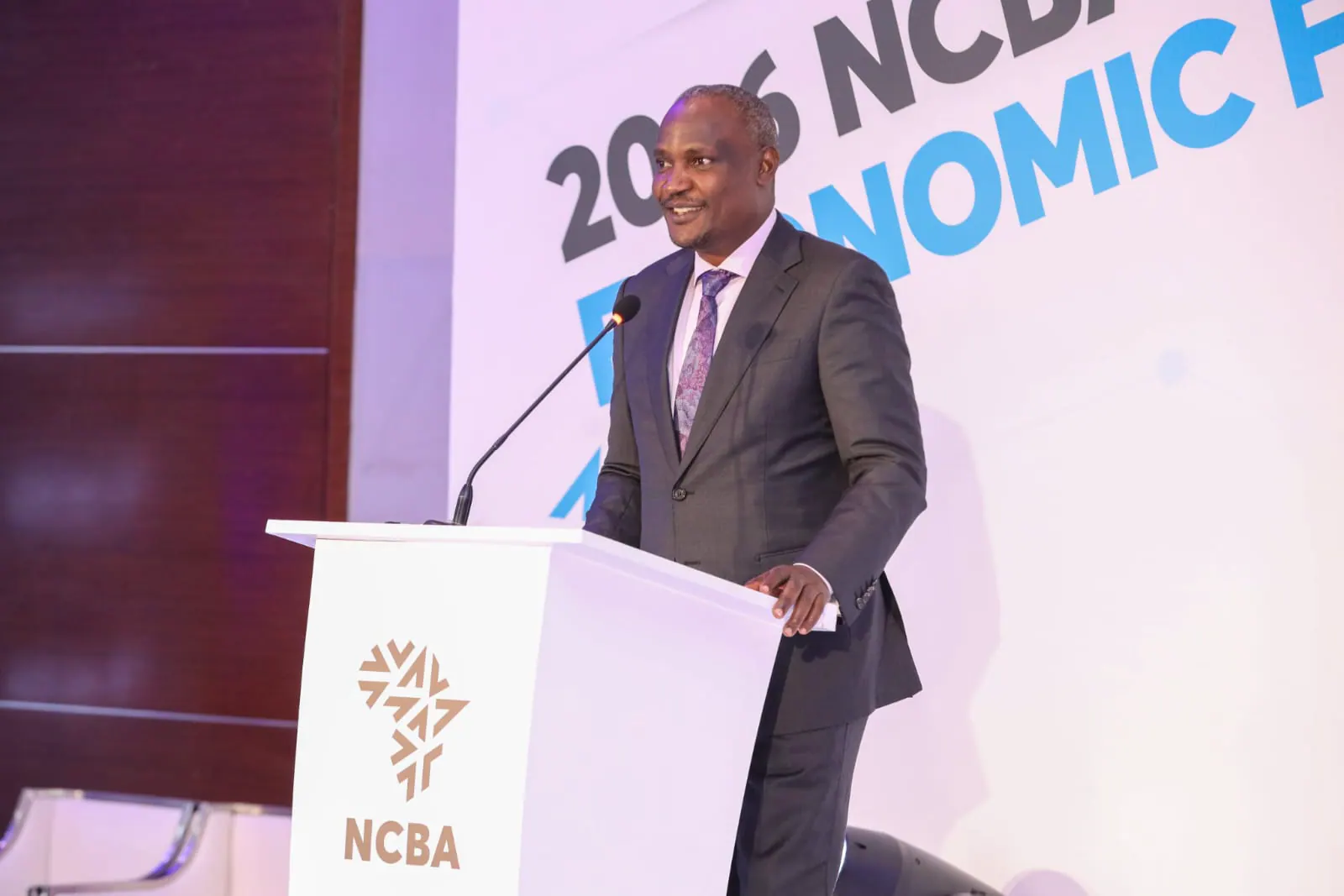
National Treasury Cabinet Secretary John Mbadi urged Kenyan banks to lower the cost of credit to consumers during the 2026 NCBA Economic Forum.
He noted that the Central Bank of Kenya has reduced the Central Bank Rate by four percentage points since mid-2024, yet the average lending rate remains at 14.4 per cent.
“Borrowers should feel more of that cut and second, lend to the real economy,” Mbadi said, adding that the government is now borrowing less from banks, freeing balance-sheet space for businesses, farmers, manufacturers and Micro Small and Medium Enterprises.
Inflation rose to 7.3 per cent in October, driven by higher fuel costs and the risk of further pressure from the war in the Middle East that has disrupted energy supply routes.
The NCBA Group projects Kenya’s GDP growth at 4.8 per cent this year and 4.5 per cent next year, with services and industry expected to grow at 4.5 per cent and 4.8 per cent respectively, down from 5.3 per cent and 5.2 per cent.
“Kenya has remained resilient year-to-date, supported by steady growth, government spending, stable interest rates, domestic and FX liquidity, and access to external commercial markets,” said Raphael Agung, NCBA Group Director for Global Markets.
Policymakers argue that Kenya needs to target at least 6 per cent annual growth to deliver jobs, while World Bank Division Director Dr Qimiao Fan warned that growth vulnerabilities persist because of public-finance pressures and a high fiscal deficit.
Dr Fan said, “Consistent fiscal deficit and high debt service cost obviously constraints fiscal space while growing reliance on domestic borrowing crowds out private sector investment and increases the risks between fiscal policy and financial sector conditions.”
Kenya’s public debt has risen to KSh13.5 trillion, representing more than 70 per cent of GDP, and interest payments consume an estimated one third of government revenue.
The NCBA Group also projects that Uganda, Rwanda and Tanzania will outpace Kenya next year with growth rates of 7 per cent, 7 per cent and 6 per cent respectively.