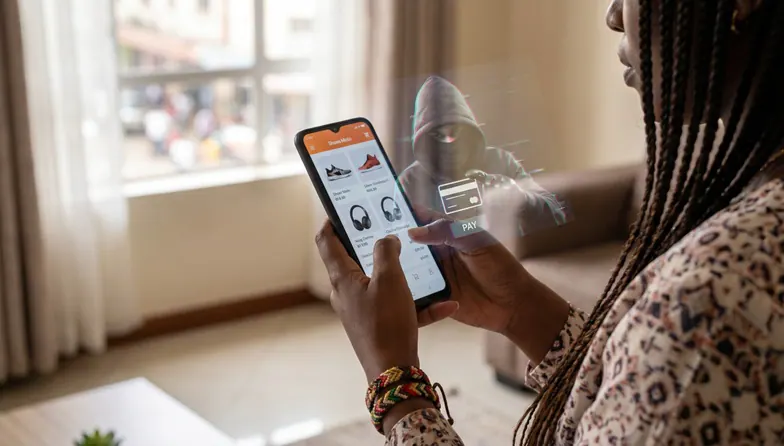
TransUnion Kenya’s H2 2026 Top Fraud Trends Report indicates that 77 per cent of Kenyans said they had been approached by digital fraud schemes via email, online platforms, phone calls or text messages in the last three months.
The same survey of 462 respondents found that 75 per cent are worried that criminals could use stolen identities to commit offences, while 42 per cent fear that their workplace systems could be accessed without permission.
Smishing, or fraudulent text messages, was the most frequently reported method at 41 per cent, followed closely by vishing – deceptive phone calls – at 40 per cent, and phishing – fake emails, websites or social media posts – at 39 per cent.
Data breaches and email phishing each raised concerns for 56 per cent of those surveyed, and 46 per cent were uneasy about personal information being intercepted on public Wi-Fi networks.
TransUnion Kenya Chief Executive Officer Morris Maina said that the use of trusted communication channels to launch fraud forces businesses to rethink how they interact with customers and protect them. “Trusted communications are often the first stage of account fraud. Businesses should therefore treat communications as part of the trust journey, rather than simply as marketing or service channels,” he said.
He added that linking communication activity with identity data, device information and account behaviour can enable organisations to spot suspicious actions earlier and intervene before losses occur.
The report also points to artificial intelligence as a key factor increasing the speed and scale of digital fraud, with criminals employing the technology to automate scams, craft convincing messages and generate synthetic identities.
Maina warned that “AI is not creating new fraud, it’s making existing fraud faster, cheaper, more convincing and dramatically more scalable.”
A global TransUnion survey revealed that 58 per cent of business leaders are very or extremely concerned that fraud risks are evolving faster than their ability to detect them, and 42 per cent said the growing sophistication is placing significant to severe pressure on their organisations.
In Africa, 94 per cent of suspected digital fraud activity among TransUnion’s clients in the first half of 2026 occurred during account login, far above the global rate of 53 per cent.
The financial services sector recorded the highest suspected digital fraud rate in Africa at 3 per cent during the same period, highlighting ongoing security challenges for digital banking, mobile-money lending and real-time payment platforms.
Maina urged firms to reinforce verification processes beyond the initial account-opening stage, especially when customers log in, change devices or SIM cards, request account recovery, update contact details or carry out unusual transactions. “Identity verification remains essential when an account is opened, but login activity, device changes, account recovery requests and financial transactions often require additional context,” he said.
He recommended a layered, risk-based fraud prevention strategy that combines identity checks, trusted device monitoring, behavioural analysis and real-time risk assessment to differentiate genuine users from criminals while minimising disruption for legitimate customers.