

Kenya recorded a 48.1% increase in visitor arrivals through its main airports and land borders during the first nine months of 2025, reaching 1.8 million travellers, as a visa-free policy and expanded flight schedules boosted accessibility and demand.
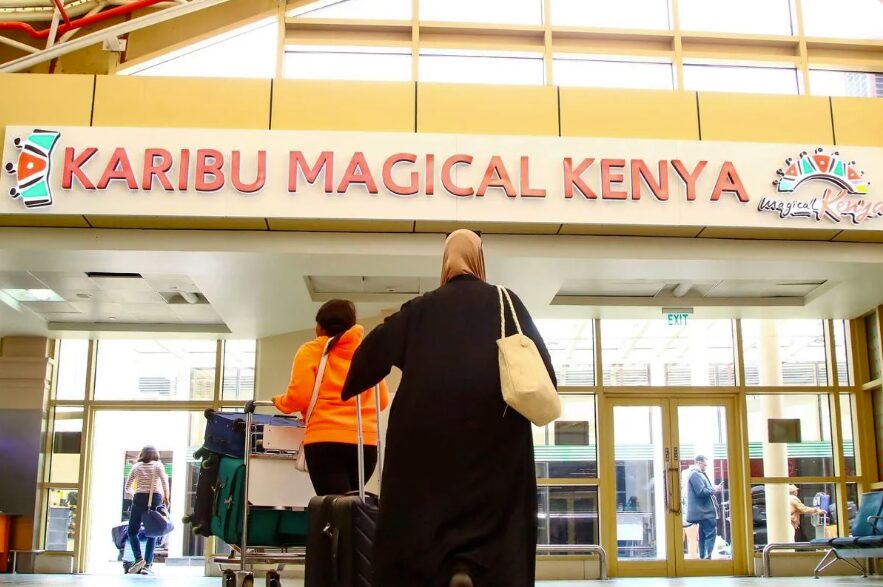
Tourism Cabinet Secretary Rebecca Miano said the growth affirms the country’s commitment to making travel easier and more welcoming, noting that the policy has positioned Kenya as a borderless destination for both safari and beach tourism.
“This unprecedented growth is a direct testament to H.E President William Ruto’s bold initiative to implement a visa-free travel policy, transforming Kenya into a truly borderless destination for global travellers,” said Miano.
Data from the Kenya National Bureau of Statistics (KNBS) shows that arrivals at Jomo Kenyatta International Airport, Moi International Airport, and other official points of entry, excluding Kenyan nationals, rose from 1.27 million over the same period in 2024.
The surge coincided with the introduction of a visa-free framework at the start of 2025 and follows Kenya’s adoption of an Electronic Travel Authorisation (eTA) system in 2024, intended to streamline visitor processing.
While the eTA generated concerns for frequent visitors from non-African countries due to its short validity and charges, the system has since been refined to reduce friction and improve efficiency.
Airline capacity expansion has also underpinned the growth in arrivals, with Kenya Airways and Etihad adding new routes, while Air France deployed larger aircraft on the Paris–Nairobi corridor.
Increased seat availability, coupled with the visa-free framework, has unlocked latent travel demand, creating stronger linkages between international travellers and Kenya’s hospitality, tour operators, and ancillary services.
Miano highlighted that visitor growth not only boosts foreign exchange earnings but also reinforces Kenya’s position as a leading regional destination.
Tourism earnings are set to benefit from the influx, following a record Ksh 352,540,000,000 generated in 2024.
Yet, sector executives remain watchful of external shocks, notably US trade policies, with President Trump’s 10% tariff imposed on selected imports from African nations, coupled with the non-renewal of the African Growth and Opportunity Act (Agoa), expected to raise the weighted average tariff on Kenyan exports to the US to 28%, a potential blow to jobs and investments.
A recent Central Bank of Kenya survey found that 64% of CEOs in tourism and manufacturing anticipate negative effects from these measures, including higher import costs, reduced exports, and lower local consumer demand.
Miano emphasized the dual importance of domestic and international engagement, underscoring that Kenya’s visa-free policy complements ongoing efforts to expand regional and local tourism.
“By easing entry, we have unlocked significant travel demand and reinforced our position as the ultimate safari and beach destination,” said Miano.
She noted that authorities are continuously refining border processes to make travel seamless for every guest, signalling a strategic approach to sustaining long-term visitor growth.
Analysts view the surge in arrivals as a clear indicator that policy interventions, when aligned with transport capacity and market demand, can drive rapid sectoral gains, even as external economic pressures remain a risk.
The challenge ahead will be sustaining infrastructure, workforce readiness, and community engagement to convert visitor numbers into measurable economic outcomes, particularly as Kenya seeks to increase tourism’s contribution to GDP beyond 10% while supporting millions of jobs.
Kenyan Business Feed is the top Kenyan Business Blog. We share news from Kenya and across the region. To contact us with any alert, please email us to [email protected]