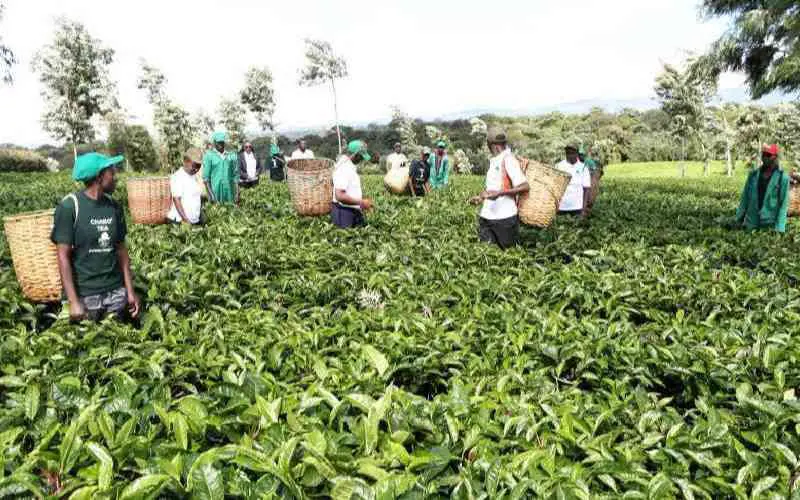
Farmers across Kenya formed long lines at commercial banks and savings and credit co-operatives to confirm and collect their annual bonus payments after the Kenya Tea Development Agency (KTDA) announced that the amounts would be credited on Monday.
The bonuses for the 2025/2026 financial year differed between factories, ranging from KSh12 to KSh50 per kilogramme of green leaf.
Enos Njeru, holding national chairman of KTDA Holding, said the disbursement represented a significant milestone for an estimated 700,000 tea growers whose output underpins the national tea sector.
Celebrations were reported at the Rukuriri, Gacharage, Ngere and Mununga tea factories, while other growers voiced disappointment with the rates received.
Solomon Njoroge of Gatanga, Murang'a County, who delivered 5,600 kilogrammes of green leaf between July 1, 2025 and June 30, 2026, said he was pleased with the amount but felt it fell short of expectations and called for a target of KSh70 per kilogramme next year.
Mary Chelang’a of Bomet County described the payment as heartbreaking and urged that future bonuses be raised to protect farmers’ interests.
Njeri Mburu, a leaseholder of three acres in the Ragati area of Mathira East, Nyeri County, appealed to factory boards to adopt innovative measures and expressed hope that the next payment would exceed KSh50 per kilogramme.
At the Rukuriri factory in Embu County, manager Joseph Rwanjau oversaw a payout of KSh50 per kilogramme of green leaf delivered during the year.
Newton Njiru attributed the improved earnings to better farming practices and proper plucking, noting that Rukuriri recorded its strongest payment in three years, a result he linked partly to Njeru’s leadership.
In Meru and Tharaka Nithi counties, the payouts were lower, with Imenti paying KSh48 per kilogramme, Kiegoi KSh45.70, Githongo and Kinoro KSh37 each, Kionyo KSh36, Weru KSh34.70, Igembe KSh36 and Michiimikuru in Tigania East the lowest at KSh20.
Batista Kanyaru, chairman of tea directors in Zone Seven, called for the abolition of the 0.8 per cent levy, arguing that the tax and the Kenya Bureau of Standards levy, which rose from KSh400,000 to KSh4 million, have added to growers’ costs.
Kanyaru also highlighted disruptions linked to the Iran-US conflict and the closure of the Strait of Hormuz, which have forced tea shipments onto longer routes and increased transport expenses.
Lawyer Ernest “Mkulima” Kimaita accused political leaders of failing to protect farmers from the levies, noting that the 0.8 per cent levy was introduced through a Gazette notice on April 1 after review by the National Assembly’s Delegated Legislation Committee.
Kimaita called for coordinated action to rescue the tea sector.
Lawyer Mugambi Imanyara made similar accusations against Meru MPs, while Abogeta West MCA Dennis “DMK” Kiogora also demanded the tax’s removal.
Farmer Daniel Kiogora urged the government to expand Kenya’s tea markets in addition to reducing the tax burden, stating that better prices and market expansion are needed.
The recent bonus disbursements have revived demands for the government and industry stakeholders to tackle production costs, enhance market access and review the taxes and levies blamed for eroding growers’ earnings.