Kenya Railways is working to finalise financing for the Nairobi Railway City project, with a target of achieving financial close in early 2027.
The KSh30 billion programme aims to transform underused railway land in Nairobi’s central business district into an integrated transport and commercial hub centred on the historic Nairobi Central Railway Station.
Procurement of the engineering, procurement and construction contractor and the supervising engineer for the central station component has been completed.
Funding for the new central station and its surrounding public realm will be supplied by the government under a memorandum of understanding with UK Export Finance, while rail and BRT infrastructure is financed by the World Bank Group, European Investment Bank, Agence Française de Développement, African Development Bank and JICA.
The government has allocated about KSh12.3 billion for preparatory works at the central station site and a new commuter rail line, with additional commitments of KSh91 billion for rail upgrades and KSh117 billion for the BRT network.
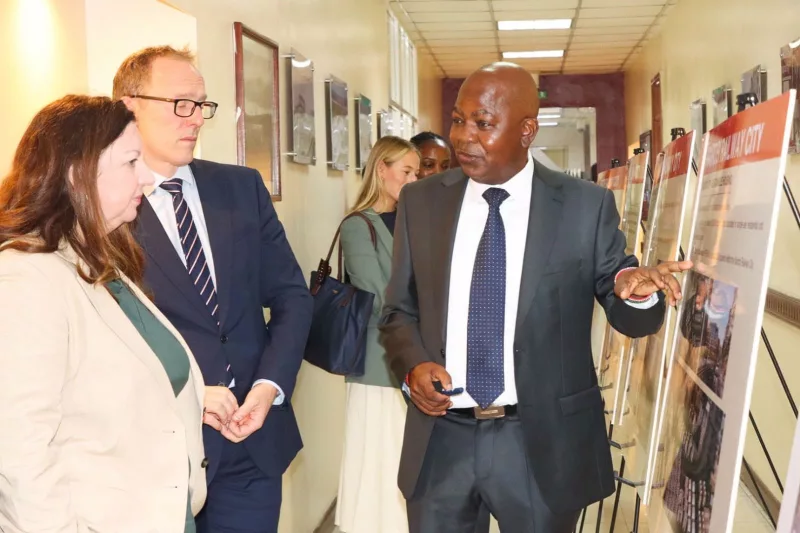
During a Thursday meeting, Kenya Railways officials met UK Minister of State for International Development and Africa Kirsty McNeill, accompanied by British High Commissioner Matt Baugh, to review progress and the role of UK Export Finance.
Managing Director Philip Mainga said the immediate priority is to close the financing gap and move the central station into construction, adding that the MICE Core development is expected to start in the coming weeks.
“Nairobi Railway City is a transformative programme for Kenya. Our immediate priority is to conclude the financing arrangements for Nairobi Central Station and move into construction,” Mainga said.
The MICE Core will comprise a modern multipurpose arena and commercial facilities aimed at conferences, exhibitions, sports and entertainment, and is intended to boost employment and position Nairobi as a regional hub for business events.
Board Chairman Abdi Bare Duale noted that decisions in the next months will determine how quickly the project moves from preparation to full implementation, highlighting the United Kingdom’s partnership.
“The United Kingdom has been an important partner in the planning and preparation of the Nairobi Railway City programme. We have reached a point where decisions taken over the coming months will determine how quickly the programme moves from preparation into full implementation,” Duale said.
UK Minister McNeill reaffirmed Britain’s commitment, citing the programme’s potential to attract investment, stimulate growth and improve urban mobility, and said UK Export Finance’s involvement reflects international financing partnerships.
“The United Kingdom remains committed to working with Kenya to advance Nairobi Railway City. The programme presents significant opportunities to attract investment, stimulate economic growth and transform urban mobility in Nairobi,” she said.
Kenya Railways is also seeking additional private-sector investment for the wider Railway City development, though details of the investment model and prospective partners have not been disclosed.
The project plans to modernise the central station to handle an estimated 400,000 daily passengers by 2030, rising to 600,000 by 2045, and aligns with Vision 2030 and other national urban and transport master plans.
Nairobi Railway City was designated a Special Planning Area in February 2020, gazetted as a Project of Strategic National Importance in May 2021, and its master plan received approval in August 2023.