Airtel Money started trading on the London Stock Exchange after an initial public offering that placed the African digital payments unit at an estimated $7 billion value, with the issue priced at £1.96 per share.
The flotation involved 270 million existing shares and generated roughly £529 million in gross proceeds.
Trading opened on Friday October 9 at about the offer price and climbed to a high of £2, representing an increase of around two per cent.
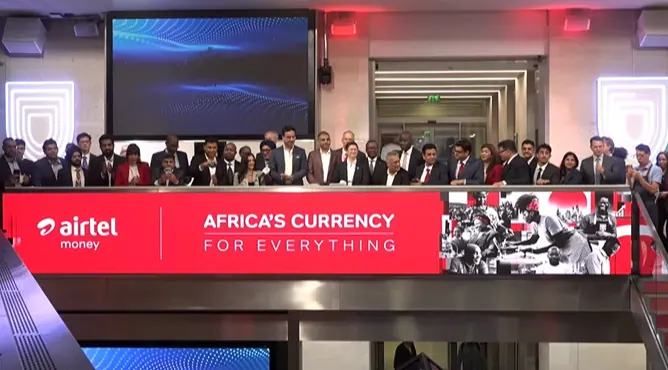
A market-opening ceremony was held at the exchange, attended by senior Airtel Money officials and representatives of the London Stock Exchange.
Julia Hoggett, chief executive of the London Stock Exchange, described the deal as a £529 million offering and highlighted the chance for public investors to participate while Airtel Africa retains control.
Ian Ferrao, chief executive of Airtel Money, thanked staff across the company’s African markets and said the listing marks the start of further growth opportunities in the continent.
The offering attracted demand several times the number of shares on offer, yet early price movement was measured rather than dramatic.
Dealogic data show the transaction to be the largest LSE IPO since Fermi Inc’s dual listing in September 2025.
Because the shares sold were existing holdings, the proceeds mainly returned to the selling shareholders rather than providing new equity capital for the business.
The listing gives Airtel Money a public market price, a broader investor base and a reference point for valuing the unit within the wider Airtel Africa group.
A cornerstone investment of $90 million from the International Finance Corporation was part of the IPO context, offering support but not eliminating market risk.
Conditional trading began on October 9, with unconditional dealings and formal admission scheduled for October 14.
The company reported about 53 million monthly active users across 13 African countries, supported by 2.3 million agents and 490,000 merchants.
In the twelve months to June 30, 2026, Airtel Money processed roughly $213 billion in payment value, a metric distinct from revenue.
The business leverages Airtel Africa’s telecommunications customer base and distribution network to link airtime purchases, transfers and merchant payments.
Competition in Kenya includes Safaricom’s M-PESA platform, while Airtel Money is developing a Mastercard virtual card and expanding into lending, savings, insurance and merchant services.
The impact of these new products will depend on customer uptake, fee structures and how they compare with existing options.
Proposed legislation such as Kenya’s National Payment System Bill 2026 could reshape regulatory oversight, though Airtel Money operates under varied rules across its multiple jurisdictions.
The flotation provides investors with a direct avenue to an African fintech firm and adds a sizeable technology business to the London market, while future trading and financial results will determine whether the $7 billion valuation endures and whether other African firms follow suit.