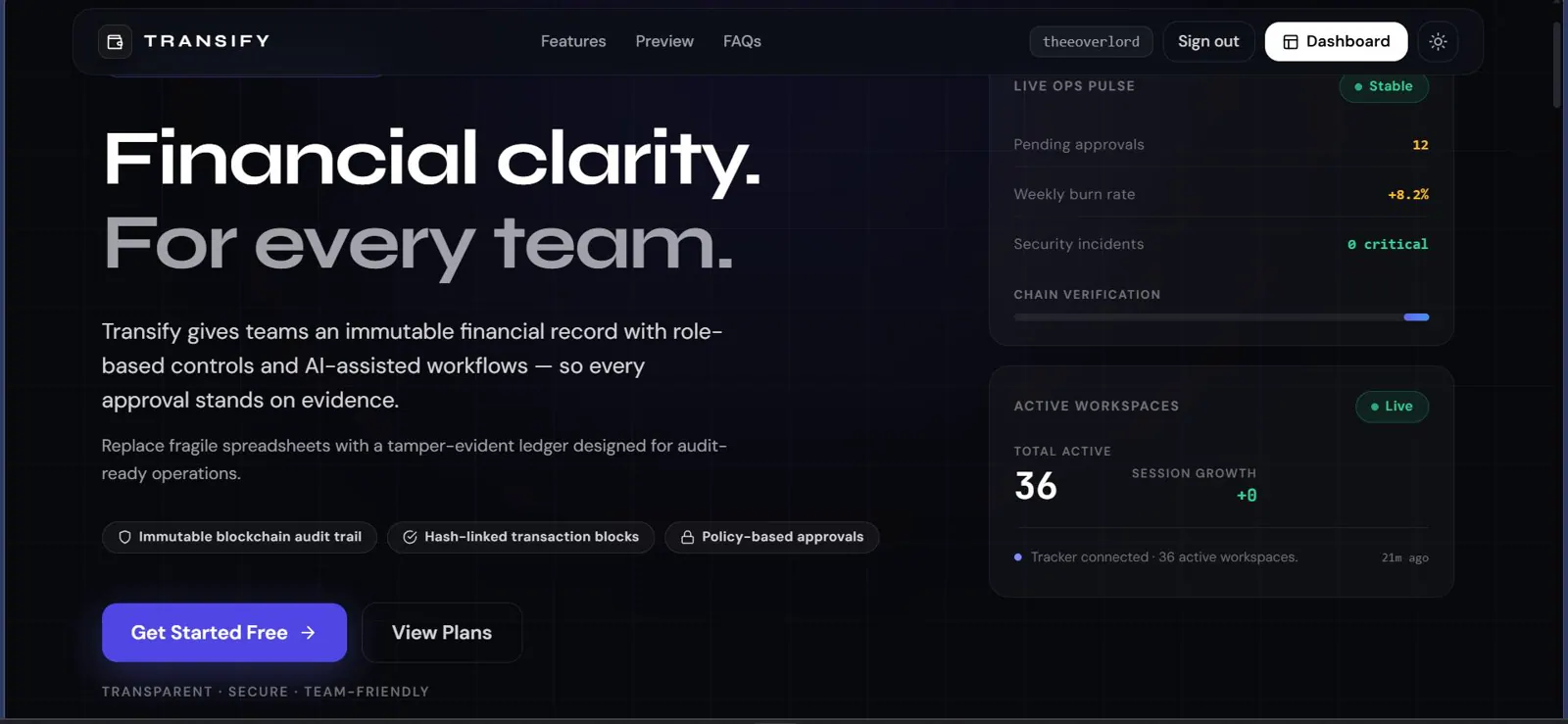
Transify, a Uganda-built financial governance startup, has made its business-to-business software-as-a-service platform publicly available for small and medium-sized enterprises, non-governmental organisations and schools.
Founder Jay Egonda says the platform links each financial transaction to the policy applied, supporting documents and the people who approved it, while also analysing activity to flag unusual patterns and potential risks.
The service uses a subscription model with three tiers: a free Basic plan, a Pro plan at $29.99 per month that adds unlimited transactions, AI-assisted review, receipt scanning and data import/export, and an Elite plan at $79.99 per month that adds board-ready reporting, behavioural insights, risk flagging, advanced analytics and extra administrative and security controls; all tiers include an audit trail and tamper-evident sealing.
Egonda targets organisations that need stronger financial controls without the cost of enterprise systems, focusing first on East African SMEs, NGOs, donor-funded projects and schools before expanding across African markets and eventually the Gulf.
The startup competes with accounting software, expense-management tools, procurement systems and governance platforms, but distinguishes itself by combining financial intelligence with governance, connecting transactions to rules, approvals and evidence while analysing risk.
In a meeting with an officer at a government procurement agency, the officer compared Transify’s underlying model to the agency’s national e-procurement system, reinforcing the founder’s belief that the infrastructure can be offered beyond governments and large enterprises.
Customer acquisition will rely on direct relationships and the free Basic plan to allow prospective users to explore the platform, with future partnerships planned to support expansion into other African markets and the Gulf.
Egonda envisions Transify becoming a financial intelligence and governance infrastructure layer for organisations across African markets, eventually extending beyond transaction oversight to broader financial behaviour, risk identification and policy enforcement.