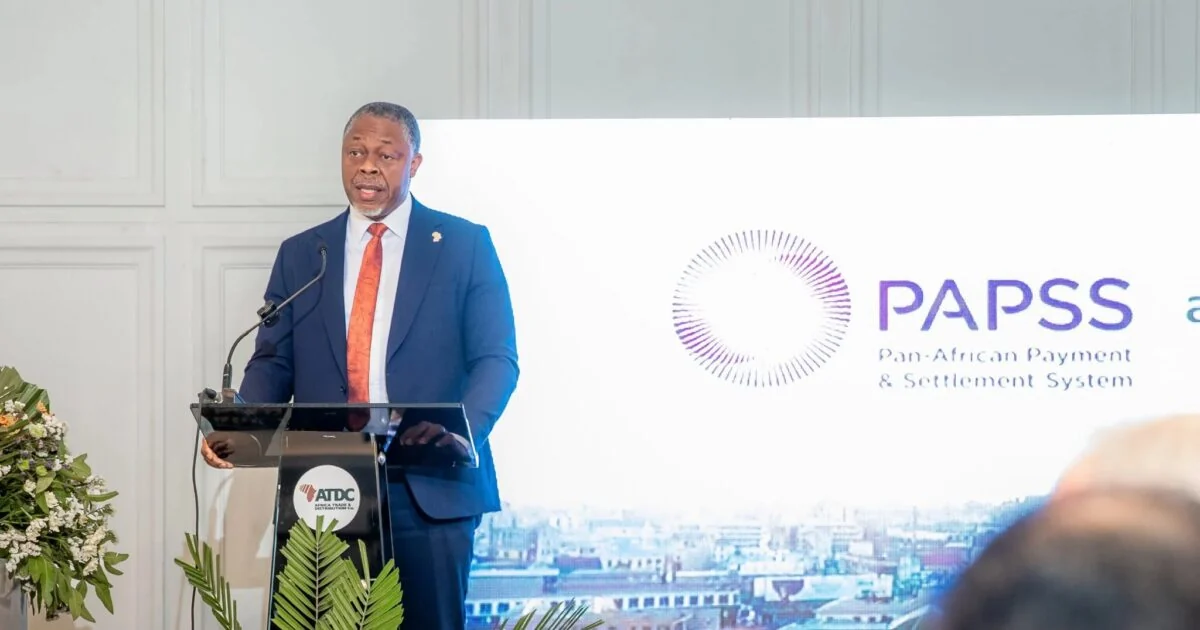
The Pan-African Payment and Settlement System (PAPSS) is widening its network across the continent, offering Kenyan firms the chance to lower cross-border payment expenses and rely less on foreign currencies.
The platform lets companies send and receive funds directly in the currencies of participating African nations, matching opposite-direction payments so that only the net amount needs settlement in an agreed currency.
Chief Executive Officer Mike Ogbalu explained that this offsetting mechanism reduces the foreign currency required for trade.
“Instead of having to source 100 per cent of the transactions in foreign currency, only the net difference is settled. We have significantly reduced dependence on third-party currencies in transactions between countries such as Kenya and Nigeria,” Ogbalu said.
Under the system, a Kenyan exporter can be paid in Kenyan shillings while a Ugandan buyer settles the invoice in Ugandan shillings.
Ogbalu added that transactions are completed in under 120 seconds, a stark contrast to the several days often needed for traditional bank transfers.
PAPSS caps its average infrastructure fee at roughly 0.1 per cent of the transaction value, whereas conventional cross-border payments and remittances typically cost between 8 and 10 per cent.
He noted that some participating financial institutions add their own margins, limiting the pass-through of these savings to end users.
“One of the key design principles for us was how to lower the cost of transactions. Our average fees now total about 0.1 per cent of the value. We are still dealing with participants who sometimes mark up our low costs, meaning the service does not reach customers as affordably as we intended,” Ogbalu said.
Kenya is among the early adopters, with local banks such as KCB Group and Equity Bank already linked to the network.
The platform still needs to convert its technical integration into broader usage, especially among small and medium-sized enterprises that could benefit from cheaper regional trade.
Ogbalu reported that adoption grew by more than 1,000 per cent between last year and this year, though he did not disclose transaction volumes or specific economic gains for Kenyan businesses.
PAPSS now operates in 31 African countries, having integrated over 220 commercial banks and 17 payment switches, including 12 national switches.
The organisation aims to reach 37 countries by the end of 2026 and at least 50 countries in 2027, with a shift toward driving higher transaction volumes and business uptake.
In addition to payments, PAPSS has launched an Africa Currency Marketplace to match supply and demand for African currencies and a card scheme intended to enable intra-continental payments without relying on external settlement infrastructure.
The expansion aligns with African governments’ push to deepen intra-African trade under the African Continental Free Trade Area, where fragmented payment systems and currency convertibility remain key challenges.