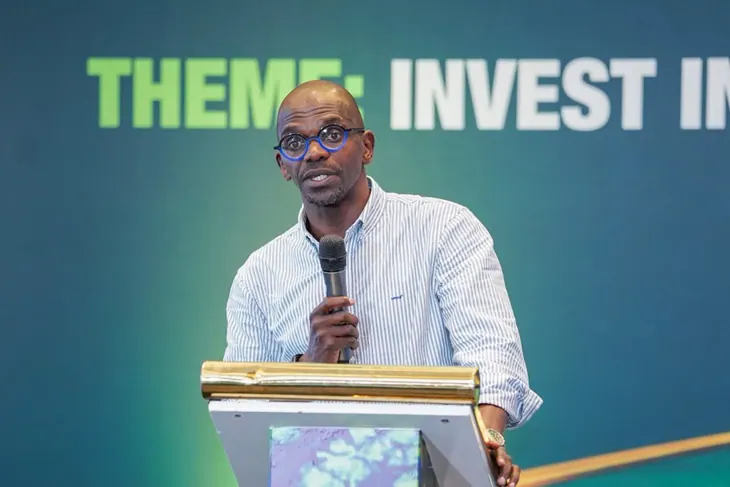
At the Abojani Economic Empowerment Conference, Raphael O. Agung, Group Director, Global Markets and Chief Economist at NCBA Group, warned that global economic uncertainty is reshaping markets and urged investors to move beyond conventional assumptions.
Agung said successful investing depends more on understanding the broader economic environment and spotting emerging opportunities than on trying to predict short-term market moves.
He outlined six lessons, beginning with the principle to “trust, but verify” information, encouraging investors to test assumptions against evidence and statistics.
He reminded the audience that markets operate in cycles, so strategies that succeed in one phase may falter in another, and stressed the need to reassess positions as conditions evolve.
Agung cautioned against herd behaviour, urging confidence to challenge prevailing opinions while noting that contrarian moves require discipline and patience.
He highlighted the importance of understanding one’s role within the market ecosystem, identifying information advantages, and maintaining curiosity and continuous learning, even drawing insights from fields such as music and sport.
Citing the World Uncertainty Index, Agung said it had risen to 4.3 times its 2024 level, underscoring the heightened risk environment.
He noted that shifts in major economies, bond yields and interest rates affect borrowing costs, currency movements, capital flows and the attractiveness of various investment opportunities.
Agung pointed to a rebalancing of global economic power toward the East, which could reshape trade and investment patterns, making international developments as important as domestic indicators.
Turning to East Africa, he urged investors to look beyond headline GDP growth, considering debt levels, foreign-exchange reserves and political stability when evaluating Uganda, Tanzania, Rwanda and Kenya.
For Kenya, Agung projected GDP growth of 4.8 per cent in 2026 and 4.5 per cent in 2027, and described interest rates as relatively stable with adequate liquidity.
He added that exchange-rate trends, reserve buffers, bond-market activity and equity developments should also inform investment decisions, as different asset classes react differently to economic shifts.
Agung concluded that intelligent investing is less about perfect forecasts and more about preparing for multiple possible outcomes, stressing informed decision-making and financial literacy.