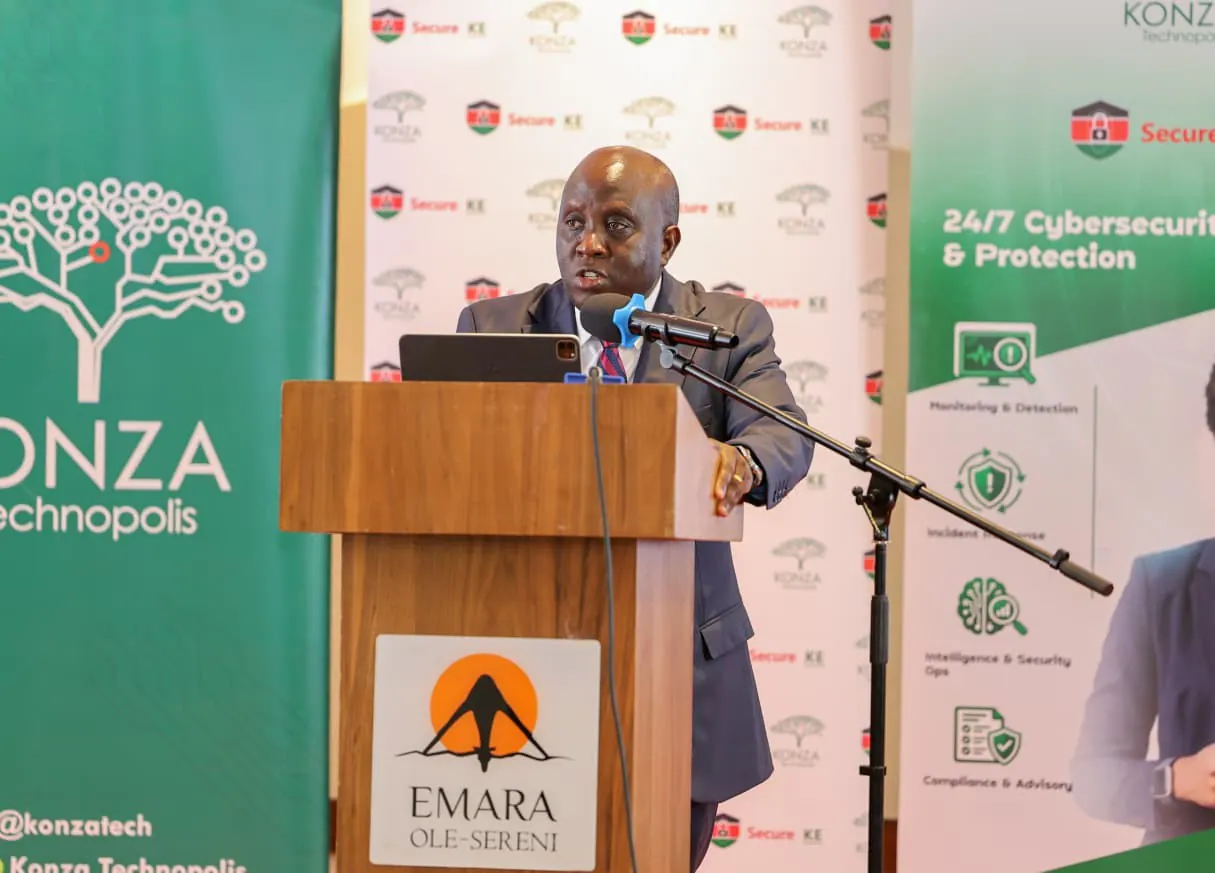
Kenya inaugurated the SecureKE Sovereign Security Operations Centre at Konza Technopolis, with Principal Secretary John Tanui of the State Department for ICT and Digital Economy presiding over the launch.
The centre is intended to deliver shared cybersecurity services, including round-the-clock monitoring, artificial-intelligence-enhanced threat detection, incident investigation, vulnerability management and coordinated response, to both public bodies and private firms that lack their own security operations facilities.
Its establishment coincides with the country’s Digital Superhighway programme, which has moved many services such as eCitizen online and recorded 58.5 million mobile data subscriptions by June 2025, thereby expanding the digital attack surface.
Tanui referenced data from the Kenya Computer Incident Response Team Coordination Centre showing roughly 4.56 billion cyber-threat events between October and December 2025, and noted that banking-related cyber-fraud losses reached about KSh1.9 billion in the same year.
“Cybersecurity is not only an ICT concern. It is a national security priority, an economic imperative and a responsibility of institutional leadership,” Tanui said, urging senior officials to embed cyber risk management in planning, governance and budgeting.
The shared-service model is designed to overcome cost and technical barriers, while the sovereign infrastructure aims to keep control of data governance and access management within Kenya and to support the nation’s Cloud First strategy.
Tanui challenged the Technopolis Development Authority and the SecureKE team to define clear service commitments, governance safeguards and measurable performance indicators, adding that “SecureKE’s success must be judged not by the number of institutions connected, but by how much more secure and resilient they become.”
The launch also aligns with the forthcoming National Cybersecurity Agency, which is expected to provide a coordination framework for cybersecurity institutions, capabilities and incident-response efforts across the public sector.
SecureKE is projected to nurture local cybersecurity expertise, generate employment and facilitate knowledge transfer to Kenyan professionals and technology companies, with Tanui calling on private-sector partners to sustain innovation and responsible threat-intelligence sharing.
In a related statement, Tanui warned that the expansion of digital payments, eCitizen and cloud services has heightened exposure to attacks, asserting that “We cannot build a digital economy without securing the infrastructure, systems and data on which it depends.”
Konza Technopolis chief executive John Paul Okwiri said the centre complements the Konza National Data Centre by providing continuous monitoring, intelligent threat detection, proactive hunting, incident-response support and AI-driven security automation, and invited ministries, state corporations and private entities to collaborate with SecureKE.
The initiative comes amid rising cyber threats, with the Communications Authority in October 2026 flagging brute-force attacks on government and cloud providers and an increase in web-application attacks on websites and ISPs, while a November 2025 parliamentary report listed several public institutions—including the National Drought Management Authority and the Kenya Ports Authority—as victims of data breaches and personal-information leaks.