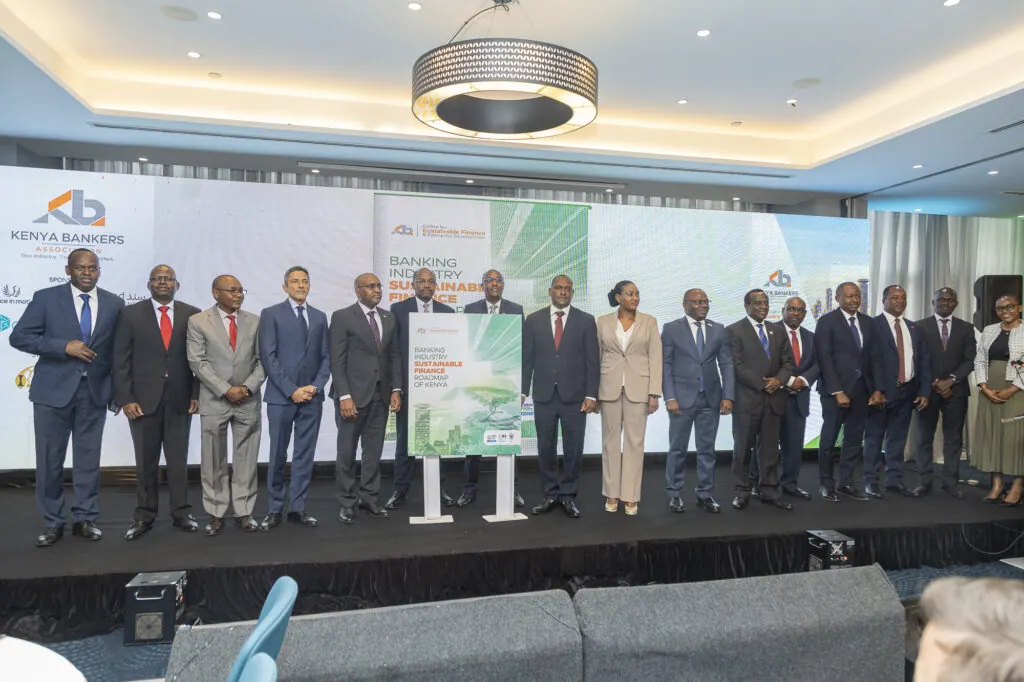
Kenya’s banking industry unveiled the Banking Industry Sustainable Finance Roadmap, a 2027-2037 framework to guide financial institutions in scaling sustainable finance, at the Banking Industry Sustainable Finance Summit 2026 in Nairobi.
The roadmap was prepared by the Kenya Bankers Association (KBA) Centre for Sustainable Finance and Enterprise Development with support from the International Finance Corporation (IFC) and WWF-Kenya.
It aims to embed sustainability information in lending decisions, risk management and capital allocation and proposes a pilot sustainable finance tracker in 2028 followed by annual public reporting.
The framework calls for interoperable reporting infrastructure by 2029, integration of priority climate and nature datasets into financial risk analysis by 2030, and a distinction between financial inputs and verified outcomes by 2031.
Implementation is divided into three phases – foundation (2027-2032), scale-up (2032-2035) and consolidation (2035-2037) – with milestones such as a baseline for MSME financing gaps by 2028.
KBA Chairman and KCB Group CEO Paul Russo said “The roadmap offers an opportunity to consolidate the industry’s progress” and that it will guide banks in directing capital toward green projects while improving climate-related risk management.
KBA Chief Executive Officer Raimond Molenje said “This roadmap offers an opportunity to bring together the various strands of work underway” and that it provides a clearer path for scaling sustainable finance.
Principal Secretary in the Ministry of Environment, Climate Change and Forestry Festus Ngeno said “Environmental protection must be understood not merely as a conservation responsibility, but as an essential part of our economic planning and long-term prosperity.”
IFC Regional Director for Eastern Africa Mary Porter Peschka said “The launch of the Banking Industry Sustainable Finance Roadmap marks an important milestone for Kenya’s financial sector.”
WWF-Kenya Chief Executive Officer Jackson Kiplagat said “This roadmap marks an important transition from policy commitments and voluntary sustainability initiatives to measurable institutional action.”
A KBA and WWF-Kenya study cited in the roadmap found all commercial banks have adopted sustainable finance guiding principles, 83 per cent use KBA-developed disclosure templates aligned with the Task Force on Climate-related Financial Disclosures, and 73 per cent comply with Central Bank climate risk guidelines.
The study also noted that climate-aligned lending remains a small share of portfolios and that data on sustainable finance volumes, pricing and performance are limited, highlighting the need for better monitoring.
At the GreenShift Forum 2026, sustainability professionals highlighted practical ESG reporting challenges, with Julie Salerno describing an audit of roughly 800 data points where employee-tenure information conflicted with financial statements, requiring corrections to ESG risk ratings.
Collins Kinoti warned that selective disclosure is “the worst form of greenwashing” and could expose businesses to investor lawsuits as assurance requirements expand.
The reporting challenge extends to corporate clients, where inconsistent data across departments hampers banks’ ability to assess environmental risks, a problem technology providers aim to solve.
Ardena Consulting’s platform, noted by TechTrends Kenya, consolidates sustainability information from finance, human resources, procurement and utilities, providing audit trails and calculation methods to support reporting under various frameworks.
Kui Kinyanjui, speaking at GreenShift, said solar investment had cut electricity spending by about 20 per cent annually, illustrating how reliable data can demonstrate the commercial impact of sustainability projects.
The roadmap’s emphasis on common reporting and monitoring approaches creates opportunities for technology firms developing data collection, reporting, risk analytics and environmental monitoring tools.