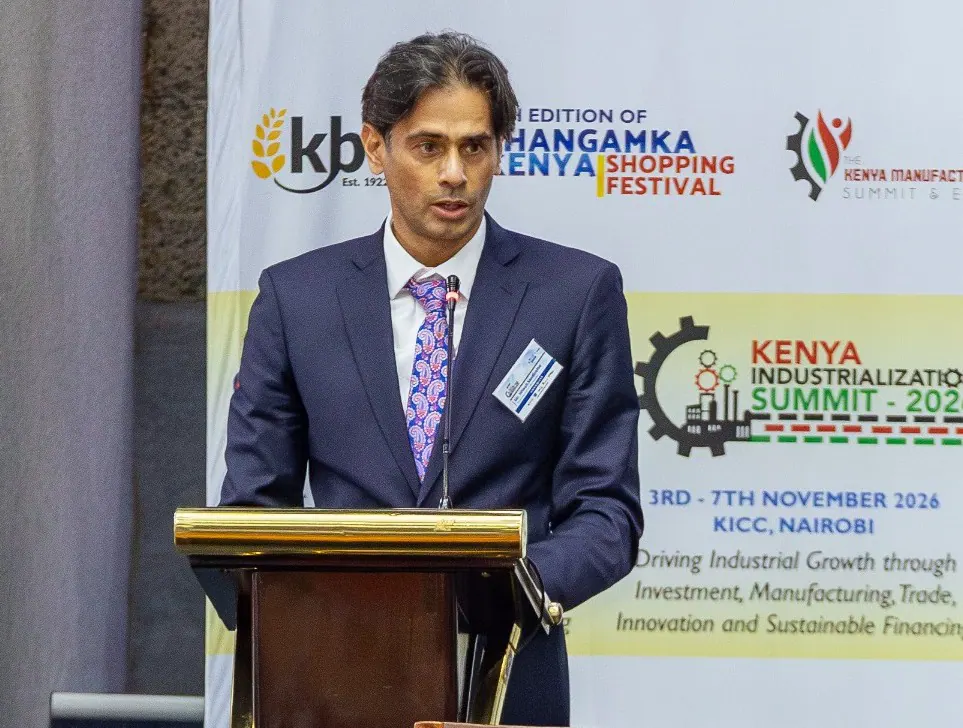
The Kenya Association of Manufacturers (KAM) urged a more predictable policy environment, harmonised regulation and decisive interventions to boost domestic industrial competitiveness at the fourth Kenya Industrialisation Summit.
The summit was held at the Kenyatta International Convention Centre and was co-located with the ninth Changamka Kenya Shopping Festival; President William Ruto and Cabinet Secretary for Investments, Trade and Industry Lee Kinyanjui addressed delegates.
President Ruto reaffirmed the government’s aim of raising manufacturing’s contribution to gross domestic product to 20 per cent and creating one million formal industrial jobs by 2030, saying Kenya should produce more of what it consumes, add value to what it grows and sell more of what it manufactures.
He noted a strategic shift toward emerging sectors such as renewable technologies, artificial intelligence and geothermal-powered data infrastructure, and pointed to the expansion of Special Economic Zones, now 36 nationwide, with investors requesting nearly 7,000 acres at the Dongo Kundu hub.
Ruto highlighted seven legislative reviews and the planned elimination or reduction of 85 distinct levies, estimating that rationalising licences will save the private sector KSh300 million annually.
He also flagged high energy costs, citing average commercial and industrial power tariffs of KSh23.70 per kilowatt-hour between 2023 and 2025, which exceed rates in Uganda (KSh16.02), Tanzania (KSh12.52), Rwanda (KSh10.10), Ethiopia (KSh2.56) and other continental hubs.
To address the tariff gap, the president announced plans to raise national generation capacity from 3,000 megawatts to 10,000 megawatts using geothermal, solar, wind and hydro resources.
KAM Board Chairperson Hitesh Mediratta warned that industrial investment needs institutional stability and relief from overlapping fiscal regimes at national and county levels, and cited 320 stay applications published in the East African Community Gazette on June 30, 2026 as evidence of cross-border trade disparities.
Mediratta presented three urgent fiscal demands: first, to double monthly allocations for verified value-added tax refunds from KSh2.5 billion to KSh5 billion to clear a backlog of about KSh50 billion and to operationalise Section 47 of the Tax Procedures Act for direct tax offsetting; second, to extend export incentives beyond Export Processing Zones and to provide full rebates or exemptions on excise duties paid on inputs for export goods; third, to mobilise coordinated intelligence at borders and retail channels to combat counterfeit, uncustomed and undervalued goods, which he said cost the domestic economy between KSh800 billion and KSh1 trillion annually.
The summit ran alongside the Changamka Kenya Shopping Festival, which features roughly 400 domestic producers showcasing locally manufactured goods through November 7.