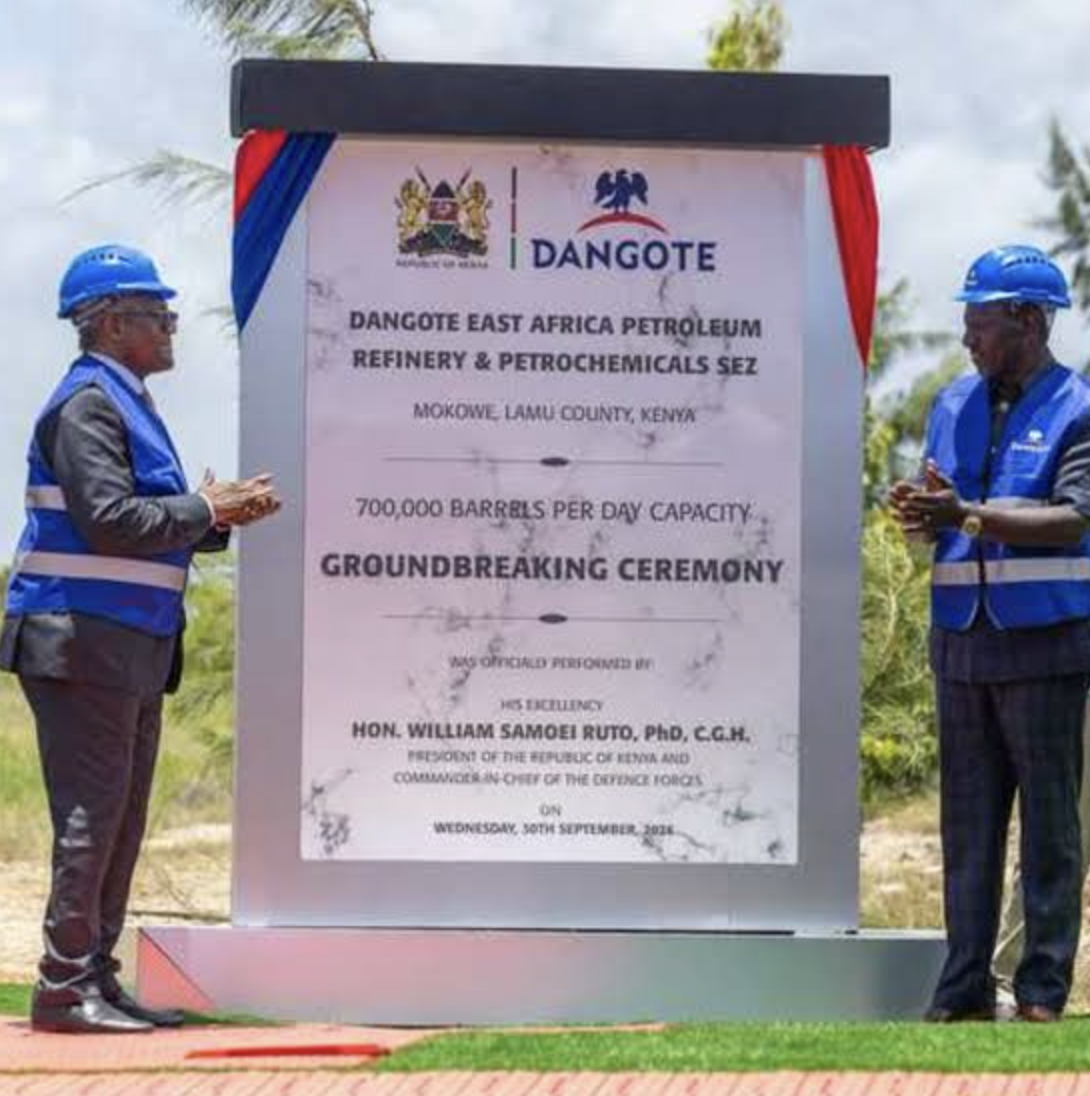
Dangote Group has officially broken ground on a US$16 billion (about KSh2.1 trillion) oil refinery in Lamu, setting in motion one of the largest industrial investments ever undertaken in Kenya.
Construction of the Dangote East Africa Petroleum Refinery was launched on Wednesday, September 30, with the planned facility designed to process 700,000 barrels of crude oil per day once completed.
The project is expected to position Lamu as a major regional energy and industrial hub while reducing East Africa’s reliance on imported refined petroleum products.
The refinery is targeted for completion in about 40 months, with operations expected around 2030.
Regional Market at the Centre of the Project
Unlike a refinery built primarily for one domestic market, the Lamu facility is being positioned to supply Kenya and neighbouring East African economies, processing crude sourced from African producers.
Dangote has said the project is intended to keep more of Africa’s oil value chain on the continent by processing crude locally instead of exporting raw petroleum and importing finished fuels.
The company is also looking beyond petrol and diesel. The development is expected to support related industries including petrochemicals, bitumen and base oils, while jet fuel could also be exported to international markets.
The project is expected to create more than 50,000 jobs, with some estimates putting employment at about 60,000 during its development and operation.
Engineering Contracts Already Taking Shape
Major engineering firms are already securing work from the project.
India’s Engineers India Limited has reportedly secured a contract worth more than US$450 million, while US-based Honeywell Technologies has been selected for engineering, technology licensing and equipment work estimated at about US$300 million.
The two companies also worked on Dangote’s large refinery in Nigeria, allowing the group to draw on experience gained from developing the Lagos facility.
A 1,000-megawatt power plant is also planned as part of the wider Lamu development.
Legal and Environmental Questions Remain
The project is proceeding against the backdrop of a land dispute involving residents in Lamu, with a Kenyan court recently ordering parties to maintain the status quo in contested areas pending further hearings.
Environmental groups and some residents have also raised concerns about the proposed refinery’s impact on land, coastal ecosystems and communities around Lamu. The legal dispute does not prevent the groundbreaking ceremony but could affect activity on some parts of the project site.
For Kenya, the commercial significance of the project extends beyond fuel production.
If completed as planned, the refinery could reshape regional petroleum supply chains, generate demand for logistics and industrial services, and strengthen Lamu’s position as a trade and energy gateway for East Africa.
The project will now be closely watched for how quickly it moves from groundbreaking to construction, how its financing and regional ownership structure develops, and how outstanding land and environmental issues are resolved.