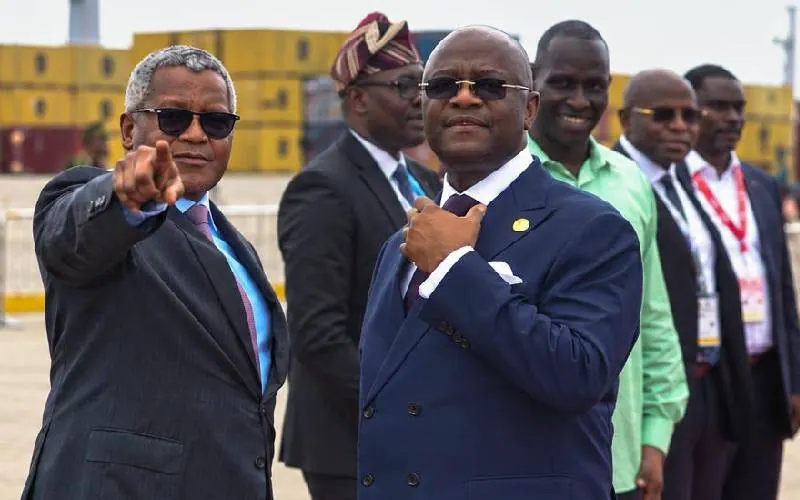
African Export-Import Bank (Afreximbank) said the 700,000-barrel-per-day Dangote East Africa Petroleum Refinery & Petrochemicals special economic zone in Lamu will help conserve Kenya’s foreign exchange reserves.
The refinery, backed by Aliko Dangote’s Dangote Group, had its groundbreaking led by President William Ruto last week.
Afreximbank President and Chairman of the Board Dr George Elombi said the investment demonstrates Africa’s capacity to finance and build major industrial assets that meet economic needs, and that refining more locally retains greater value, creates jobs and strengthens trade links.
He added that recent global energy and shipping disruptions have reminded African economies of the cost of dependence and that the project will shorten supply chains, conserve foreign exchange, strengthen regional energy security and build resilience.
The Lamu project is expected to create about 60,000 jobs and will process crude sourced from African producers such as Uganda for supply to Kenya and the wider region.
Kenya’s foreign exchange reserves stood at KSh1.95 trillion (US$15.25 billion) earlier in the month, while the shilling has remained around KSh129.48 per dollar after active central bank intervention.
Murban crude oil prices rose to KSh12,606 (US$94.70) a week earlier and diesel and kerosene prices have climbed sharply, feeding through to transport and food costs.
By refining crude locally rather than importing finished products, the Lamu refinery is expected to reduce Kenya’s exposure to global refined-product markets, lower the import bill and ease dollar demand for fuel shipments.
Since 2015 Afreximbank has invested roughly KSh1.94 trillion (US$2.5 billion) of a KSh517.9 billion senior syndicated term loan for the refinery, the largest participation in the syndicate.
Afreximbank, headquartered in Cairo, is a pan-African multilateral institution that finances intra- and extra-African trade and has supported the African Continental Free Trade Agreement, launching the Pan-African Payment and Settlement System and a KSh1.29 trillion adjustment fund.
At the end of December 2025 the bank’s total assets and contingencies exceeded KSh6.28 trillion (US$8.4 billion) and it holds investment-grade ratings from several agencies.
In Kenya the bank has launched a KSh388.4 billion climate change adaptation facility, is backing the Dongo Kundu Integrated Industrial Park and Naivasha SEZ II with about KSh129.5 billion, and in 2025 Afreximbank announced KSh103.6 billion and KCB Group contributed KSh38.8 billion towards the development of the zone.
Government projections link the industrial park and SEZ developments with roughly 140,000 jobs once fully built.
The Lamu refinery is expected to supply refined products across East Africa, reducing reliance on imports from the Middle East and Asia, a need highlighted by recent disruptions in the Strait of Hormuz, the Red Sea and Bab el-Mandeb.
In 2025 Afreximbank established KSh388.4 billion in intra-African petroleum imports, enabling African buyers to source more refined products from continental refineries.
Elombi said extending the industrial footprint into East Africa is important because Africa’s transformation will increasingly depend on enterprises investing across borders, financial institutions supporting them and governments creating enabling conditions.
The bank concluded that investments such as the Lamu refinery, emerging industrial parks and special economic zones could shift the continent from dependence on unprocessed commodity exports and manufactured imports toward an economy that produces, processes and trades for itself.